Pic: Swansea Bay University Health Board.
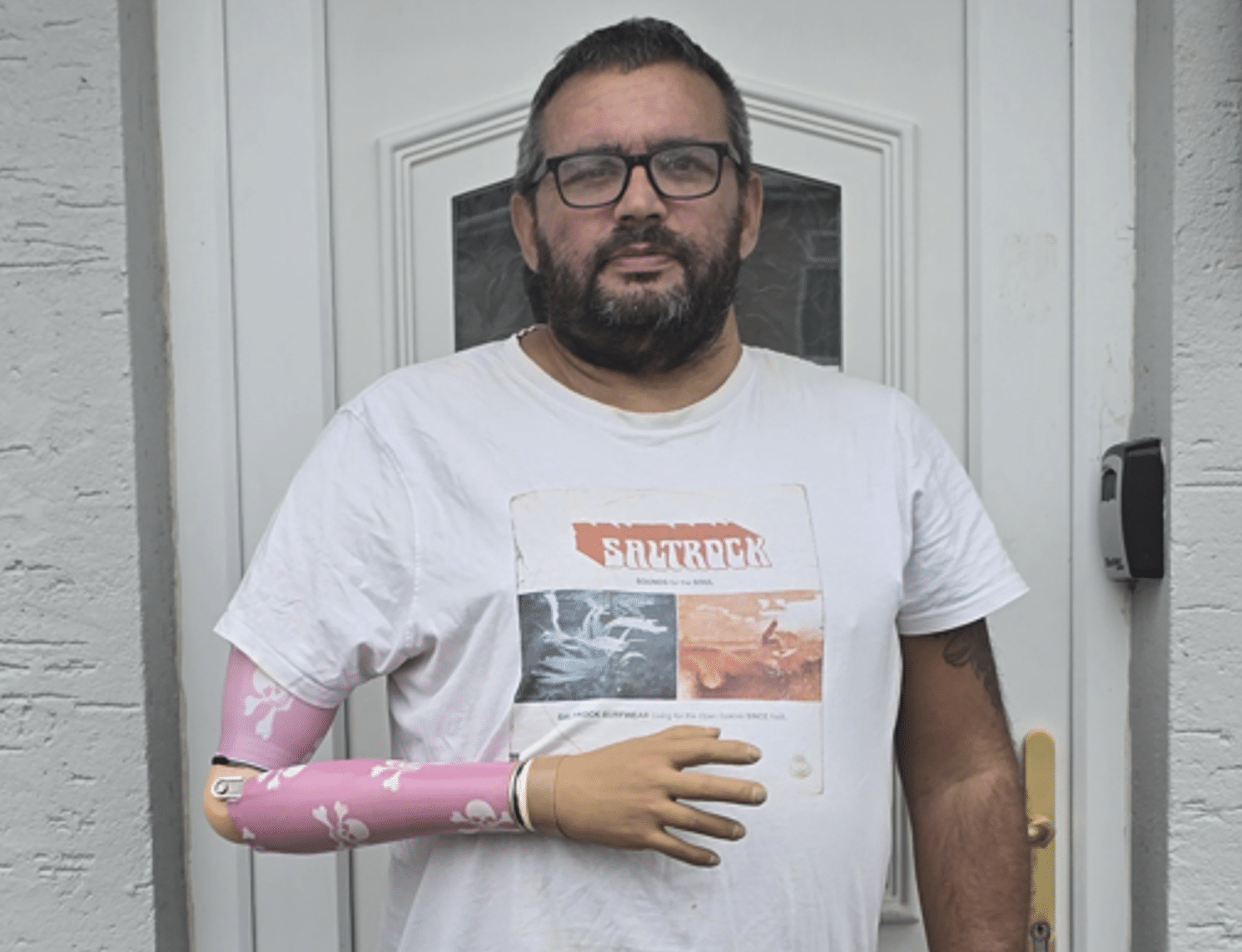
A man who struggled to come to terms with losing his arm in a crash is once again able to carry out ordinary household chores thanks to the support of the Swansea Bay Artificial Limb and Appliance Service.
Former soldier Brad Griffiths feared for his future following a life-changing collision near Whitland in west Wales.
But he has now regained the ability to do what most people take for granted, such as preparing food and changing bed covers, through a combination of learning to live with a prosthetic arm, and positive thinking.
He credits a new course run by Morriston Hospital’s Artificial Limb and Appliance Service (ALAS) for helping him to adapt.
The 45-year-old said: “In the early stages after the accident I did struggle with my mental health, in coming to terms with the loss of my arm. I was very conscious about my body image.
“And I didn’t want to see anybody, I didn’t want to do anything. I didn’t want to leave the house to do the shopping because in my head it felt like people were staring.”
Brad had been driving a lorry for work when it was involved in a collision with two other lorries in November 2022, triggering a major response from emergency services.
The father-of-three was released from the wreckage by fire crews and flown by Wales Air Ambulance to Morriston Hospital, where he spent a total of eight weeks, five in an induced coma.
When he eventually came round, he discovered he no longer had a right arm below the elbow, leaving him in despair.
ALAS provided Brad with a bespoke prosthetic arm. But they were also able to support him psychologically.
He was one of the first patients to benefit from a new online programme devised by ALAS and partners in Cardiff and Vale and Betsi Cadwaladr health boards, which operate Wales’ other prosthetic centres in Cardiff and Wrexham.
The Navigating Life After Amputation course provides wellbeing support to people who have undergone life-changing amputations, and encourages patients to support each other, in addition to their existing rehab and physical support for amputees learning to use a new prosthetic limb.
“Sometimes I will use a wheelchair if I know it’s going to be a long, physically demanding day,” he said.
“And I’ll be with ALAS for the rest of my life, but through them and the course I went on, I’ve met some amazing people and I’m still in touch with some today and we speak regularly,” said Brad.
“The bond I’ve made with some of those on the course and throughout my rehabilitation has been unbelievable. The support it gave us, and the support we give each other, has been invaluable.
“I have a case worker, and if I need her I’ll give her a call, and she usually replies within the hour.
“The course really gave me the self-confidence to think I can start living my life again.
“It gave me the chance to talk to other people who were in the same position, asking them how they feel about being an amputee, getting different perspectives.
“I felt because I was relatively young, being an amputee would make me stand out more.
“I can’t fault what ALAS has done for me. They help bring out the real you.
“I was the only upper limb amputee on the course, but everyone said it gave them strength to start doing things and getting out and about again.
“My prosthetic arm is great, but I don’t even always have to use it because I have the confidence not to.”
ALAS Principal Psychologist Dr Rebecca Antwhistle said: “Psychologists in all the centres got together and decided that because we have such big, rural patches between us, that an online programme to support amputees would be the way forward.
“It’s a nine-session programme based on acceptance and commitment therapy and aims to support adjustment to life as an amputee.
“We ask people to tune into what’s important to them in life and from there we invite them to set their goals for the programme and beyond.
“Every week participants are invited to take part in mindfulness exercises, which was a popular element of that course.
“Other topics include the understanding of the rehabilitation process; managing pain and other long-term conditions. The last session that brings it all together is focused on rethinking identity.”
She added: “Bradley has shown remarkable resilience, positivity and determination from the outset.
“He has engaged fully with the service, working closely with our prosthetics team, Occupational Therapy and Psychology, taking part in the first All Wales Navigating Life After Amputation course to support his recovery and rehabilitation.
“What stands out most is his kindness, sense of humour and commitment to helping others.
“He has openly shared his experiences and has expressed a genuine desire to support and inspire people who may be facing similar challenges.”