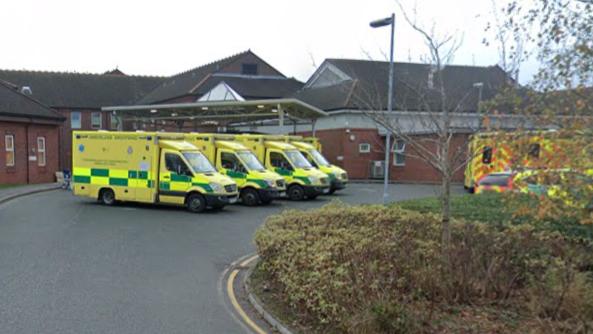
Ambulance transfers into A&E at Wrexham Maelor Hospital take on average two-and-a-half hours, breaching the Welsh Government’s 45-minute requirement.
The admission came as Wrexham County Borough Council’s Safeguarding, Communities and Wellbeing Scrutiny Committee received a joint report on Accident and Emergency performance from Wrexham Maelor, Betsi Cadwaladr University NHS Trust (BCUHB) and the Welsh Ambulance Service Trust (WAST).
WAST explained it was working to reduce patient handover times further with its electronic patient care records system.
“The Electronic Patient Care Record is effectively, is about joining up the data so that instead of going into a hospital and having our computerised information being written down by a nurse and then put onto their system, it’s about that digital enablement which will smooth over handover as well,” said Emma Wood, Chief Executive of WAST.
Wrexham Maelor is still in the early stages of adopting digital patient records however and with no single database connecting WAST with Wrexham Maelor and social care services, getting a full view of a patient’s history remains a challenge.
“We do have a new system that we’re working with,” said Ian Donnelly, BCUHB’s Director of Operations for the East Integrated Health Community.
“It’s the Right Patient, Right Bed dashboard. That system does give access to our social care colleagues to see what we’ve got in the hospital. It is pretty new and is part of our winter plan.
“They can see on that which care pathway our patients are on. We don’t have what we would call a single database with local authority social care information, the acute hospital information or community hospitals data.”
That joined-up data stream connecting patient data across hospitals, doctors, WAST and social care could help tackle a number of challenges facing BCUHB and Wrexham Maelor.
According to the report the number of people attending A&E averages around 180 patients per day.
Due to overcrowding up to 60 patients can be awaiting admission beds to a ward at any given time. The department is also failing to meet national targets on four hour waiting times – which state 95% of patients should not be waiting more than four hours for treatment or admission – and the 12 hours target which states no patient should wait 12 hours for treatment or admission.
At the Maelor since January just under 40% of patients have waited four house or more on average and almost 25% of patients have waited 12 hours or more.
Members were told that immediate measures were being put in place to try to bring those waits down including ‘call before convey’ – where ambulance crews speak to remote clinical specialists or a triage hub to determine whether a patient needs to come to A&E – and advanced paramedic practitioners (APPs) who offer an alternative initial care service for cases where an ambulance is not essential.
“Effectively APPs get work that is scheduled to them,” said Estelle Hitchin, WAST’s Director of Partnerships and Engagement.
“Their work is urgent – patients who need to be seen in a certain time frame – but they are not so urgent they require an ambulance.
“Because they are advanced they have additional skills. What you often find is that they can manage the patient in their own home effectively and discharge them in their own home with the correct treatment.
“What that’s doing for us is that an individual that maybe previously we might have conveyed to hospital, we’re not and we’re maybe not even needing them to refer back to people like their GP.
“Effectively it’s advanced treatment in the community, in your home and that is avoiding the use of our ambulances.”
Members accepted the report and the welcomed the ongoing improvements to A&E and ambulance services with the next report due in July 2027.