Swansea Bay services are playing it cool and making way with a specific spray to improve care for patients, staff and the environment.
Ethyl chloride (EC) is a fast-acting coolant spray used to temporarily numb the skin for minor medical procedures and is commonly used in services such as maternity for checking the level of epidural and spinal anaesthetic blocks.
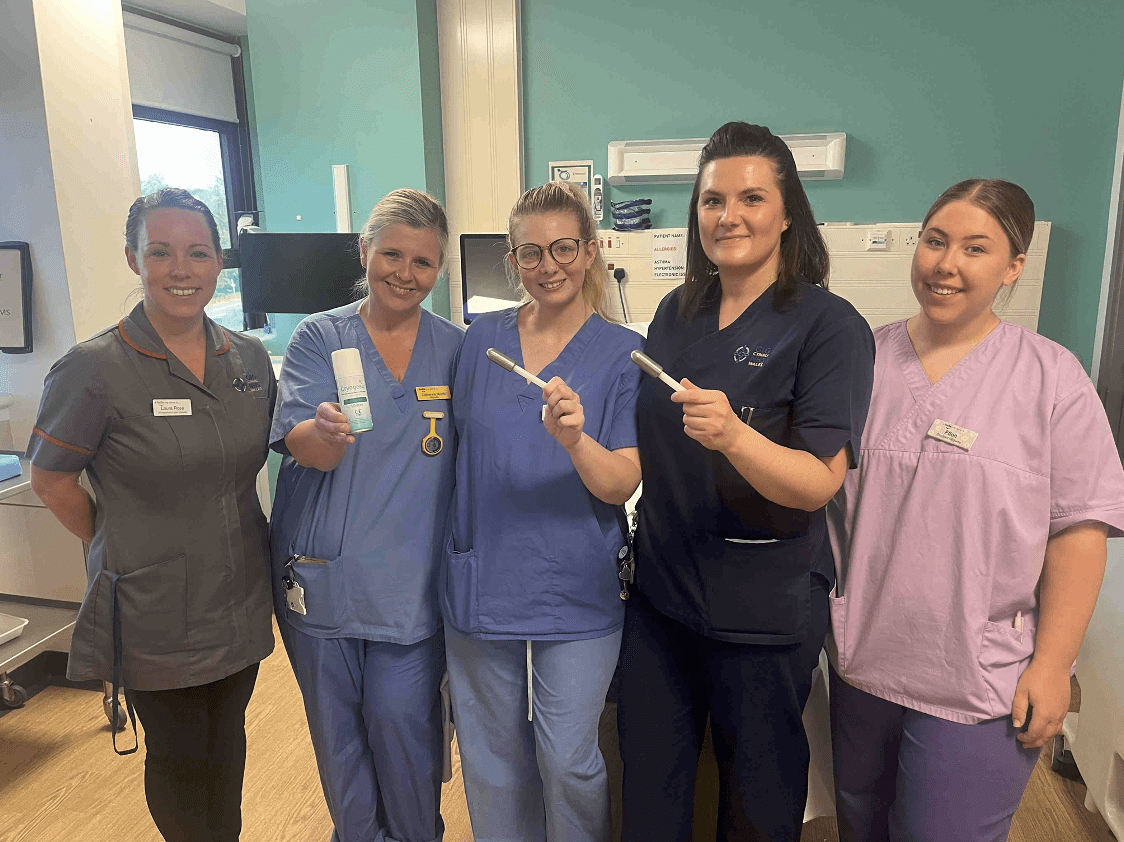
PICTURED: (From left) Laura Rose, Intrapartum Lead Midwife; Cath Morris, midwife; Shannon Davies, midwife; Danielle Clifton, Labour ward co-ordinator and Ffion Thomas, second year student midwife with the EC spray and CoolSticks.
However, it uses significant amounts of greenhouse gases.
As a result, the health board has started replacing EC with CoolSticks – a trade name for a metal device that is kinder to its patients, staff and surroundings.
The reusable sticks can be stored in a fridge or thermos flask to stay cold, and Swansea Bay clinicians have noted a more accurate reading compared to spray. They can also be cleaned with an antibacterial wipe after use.
The change will benefit patients and staff who were working regularly with EC spray, as greenhouse gases will be eliminated from the process.
Aside from its benefits in terms of care, it will save 24,647 kgCO2e – the equivalent of 312 return trips from Swansea to London in an average petrol car.
It will also save the health board over £41,000 annually if the spray is completely replaced by CoolSticks throughout its services.
Douglas Morgan, Consultant Anaesthetist, has helped implement the change within Morriston Hospital’s Anaesthetics department.
He said: “We are already using CoolSticks routinely for checking upper limb blocks for awake surgery in the Day Surgical Unit.
“Compared to the EC spray, CoolSticks have no spray radius which can falsely suggest blocks are higher than they really are on the abdomen/chest.
“They have the obvious environmental benefits and are better for patients and staff as they can inhale the gas, which can cause problems in their lungs.
“Currently there are 60 departments which use the spray, so switching to CoolSticks will have a really positive impact on our patients, staff and environment.”
The switch comes through multi-service involvement including procurement, theatres, anaesthetics and pharmacy.
Procurement provided support throughout the project by reviewing the health board’s expenditure, undertaking supplier due diligence and benchmarking pricing to ensure value for money.
Laura Rose, Intrapartum Lead Midwife, said: “The change from EC spray to the CoolSticks has been well received by patients and staff throughout our service.
“Patients have found the new devices to be more comfortable as it causes less of a reaction whereas the spray can make patients jump when it’s applied in more sensitive areas.
“Staff have quickly adapted to and welcomed the change, and it’s great that we’re also making a big impact on our emissions as well as benefiting our patients and saving money at the same time.”