
[tta_listen_btn] The political equilibrium in Wales has begun to cartwheel out of control as Reform begins to stall in opinion polling across Wales with Plaid Cymru taking the lead and Welsh Labour left in the dust and fumes of both emerging parties as they grapple for the lead position.
But the latest January YouGov polls have set the stage for a tense contest in May, with Reform and Plaid Cymru in a nail-biting contest of ‘who’s on-top.’ Although in a major shift, Plaid Cymru currently now holds a strong lead and the coming months are expected to see a fierce and highly competitive campaign from both sides.
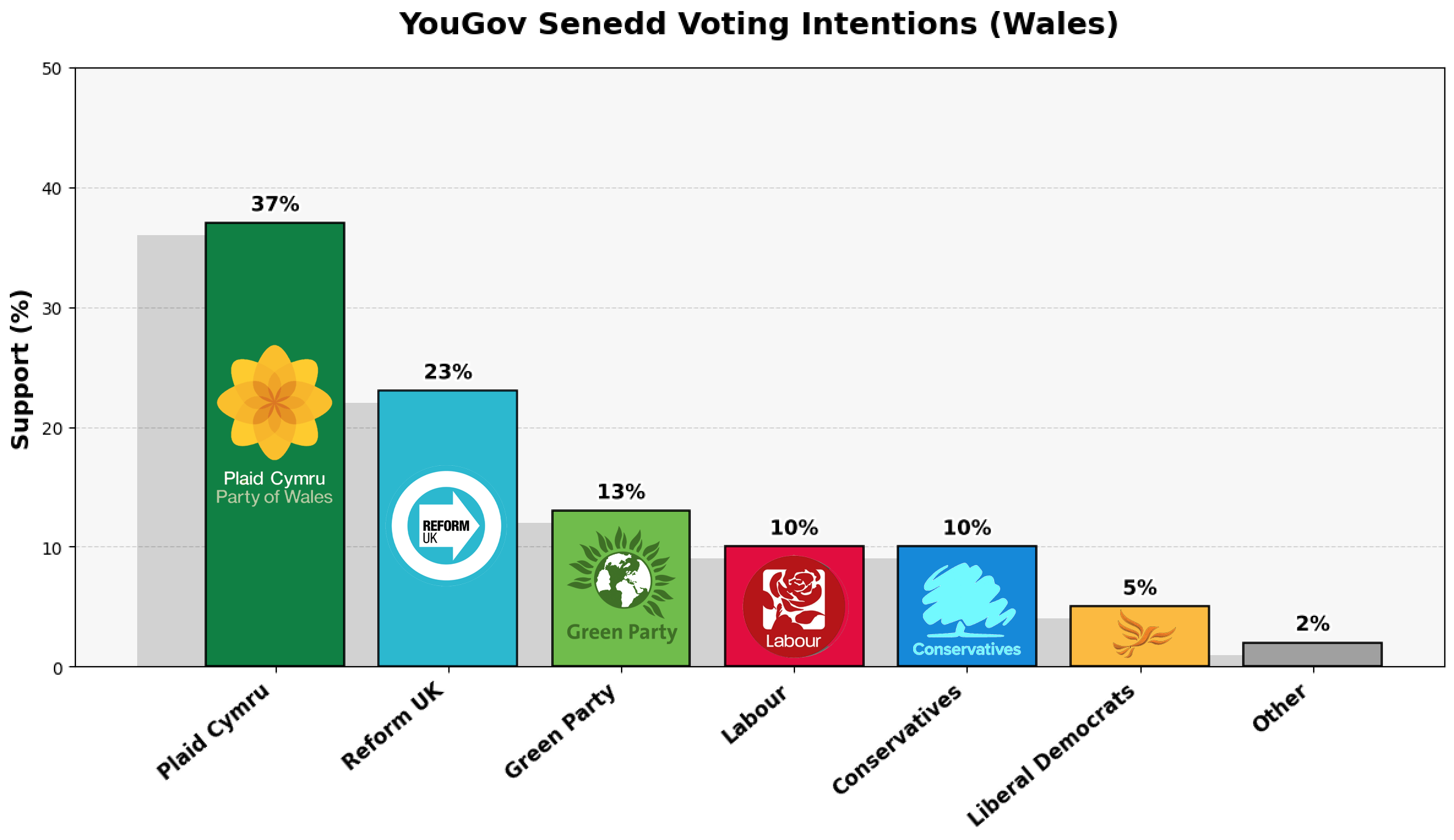
Just last year the race appeared far closer, as Reform slowly rose in popularity and threatened to overtake Plaid Cymru. That momentum now seems to have stalled. Current voter intention gives Reform just 23% of the vote, a drop of seven points. Plaid Cymru, by contrast, has surged to a projected 37%, up seven points, placing them firmly in first place. Seat projections suggest Plaid Cymru could secure 45 seats in the Senedd, only four short of an outright majority. Reform are predicted to win 23 seats, though this may shift if recently defected MSs lose their constituencies. The most dramatic collapse is seen in Labour’s numbers: they are forecast to take as few as eight seats, polling at just 10%.
Reform could win No.10, but will Wales conform?
Reform have been emerging as a strong contender for the shiny black door of No.10 in Downing Street, currently predicted to win a landslide majority (381 seats predicted). Whilst their success in England forges ahead, popularity in Wales seems to be fading. From discussions with local residents, Carmarthenshire News Online has ascertained that many are of the opinion that Reform are an ‘England first’ party, and that their grasp on the average Welsh voter is ‘overwhelmingly out of touch.’
‘To win the confidence of the Welsh people, you have to be one of us,’ says one resident. ‘You can’t sit over in England, talking about whats best for Wales when you don’t walk amongst us, share our history, our culture. You don’t understand what’s important to us.’
While Reform leads on issues like immigration, national security and tax, polls consistently show Welsh voters ranking the NHS, social care, and local economic resilience as top priorities. There is strong national pride in Wales also, with Welsh political identity firmly rooted in national culture, language, and devolved governance.
It is important to note the fact that Reform MS Laura Anne Jones has refused to rule out abolishing the Senedd stating ‘We need to try and make the Senedd work for the people of Wales, but if it doesn’t, we need to question whether the Senedd is really adding value to Wales.’
But Nigel Farage has stated in the past that he would not allow any ‘anti-devolution’ candidates t0 stand in election which puts Farage and Jones at odds with each other, making conflicting statements that suggest a deeper rift, not just between Reform and Wales but also between Reform’s politicians in Wales. A potential signal that there may be an element of factionalism or breaches in party discipline within Reform.
A widely reported disconnect with the average Welsh voter, conflicting statements on stances in Wales, coupled with recent scandals and controversies including the recent sentencing of Nathan Gill, the Welsh Reform Leader who, whilst a member of the European Parliament, allegedly received up to £40,000 to help pro-Russian politicians in Ukraine, have hurt the party’s standing in Wales.
Bribery and accepting large sums of money are sticking points that Welsh voters have a particular disdain for. When former First Minister Vaughan Gething accepted campaign donations from a waste management company whose boss had prior criminal convictions relating to environmental offences, public opinion of Vaughan Gething shifted dramatically, with an overwhelming majority calling for his resignation. This incident amongst other prior misfortunes arguably led to the downward spiral of Labour as a trusted party in Wales.
Labour’s fall of Rome
For the first time, Labour finds itself in a position where it is likely to lose Wales, one of its long-standing guarantees of power and influence in the UK. Its 10% share is the lowest ever recorded for the party in Wales, marking a monumental political shift after 25 years in power since devolution first began. Despite efforts to maintain public support, a series of scandals with former first ministers, a resulting change in leadership and widespread frustration have damaged Labour’s standing significantly. Many voters say they are tired of “broken promises” and believe Labour has taken Wales for granted after decades in control.
A pro-independence majority in the Senedd is now a realistic prospect. Both Plaid Cymru and the Greens openly support Welsh independence, while Labour has shown little enthusiasm for greater autonomy. First Minister Eluned Morgan has vocally and forcefully rejected the idea of independence, describing herself as someone who “passionately” believes in the union.
Environmental issues, particularly river pollution and renewable energy land use, have become central talking points, boosting support for the Greens. The Green Party has reached a record 13%, surpassing both Labour and the Conservatives and becoming the third-largest party by vote share. The Greens have seen a surge in membership, doubling in September 2025 and reaching 184,000 by December. Their strongest backing comes from voters aged 18 to 25, 32% of whom now support the party.
Reform, however, cannot afford to treat Labour’s collapse as an easy win. More former Labour voters now support Plaid Cymru in Senedd elections than remain with Labour. This dynamic played out clearly in the Caerphilly by-election, where Reform’s defeat came as a surprise: 30% of Labour supporters switched to Plaid Cymru to prevent a Reform victory. This setback underscores that Labour voters in Wales are still a strategic force, and that Reform faces a more complex challenge than simple voter attrition.
It is a long road before May and the Senedd Elections but it is evident from recent polling that it will be a tight race between Reform and Plaid Cymru in the months to come.