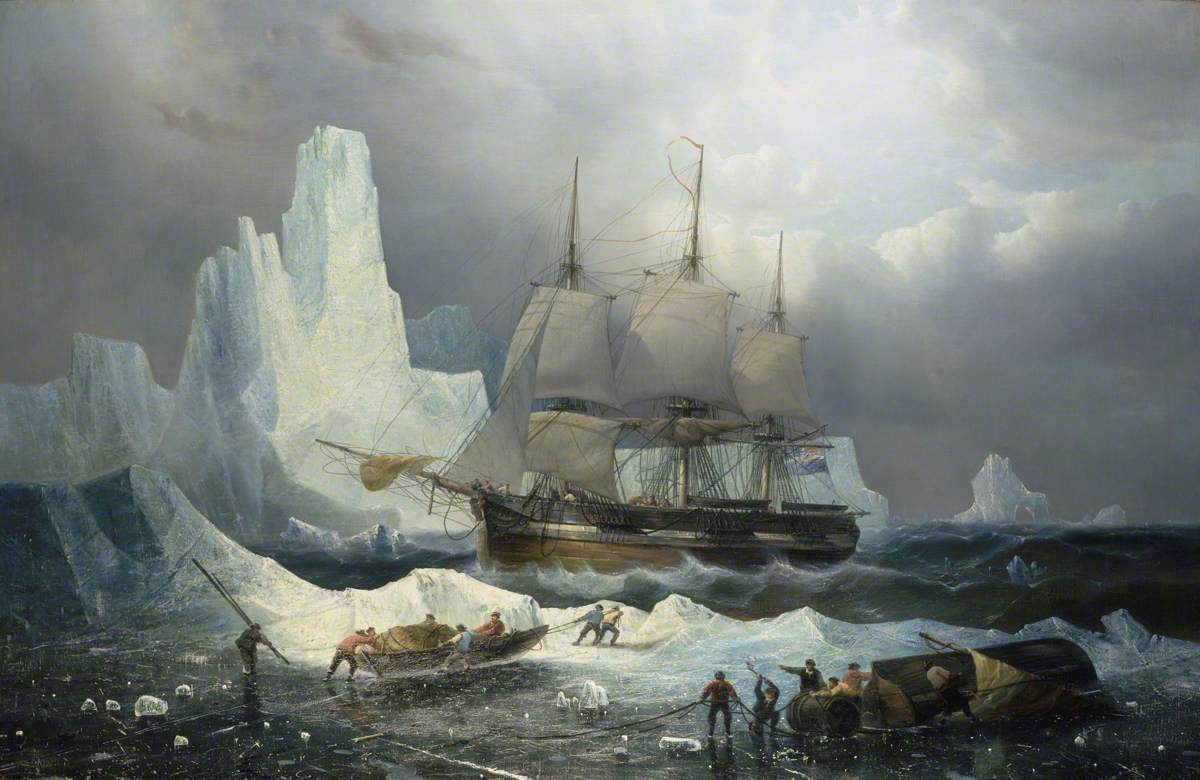
Erebus in the Ice, 1846, by François Musin
[tta_listen_btn] A ship launched from Pembroke Dock 200 years ago, which vanished in the Arctic ice and passed into legend, has given up more of its secrets. Researchers have used DNA technology to identify four more sailors who perished on the Franklin Expedition, and artefacts from the wreck are coming to West Wales for the first time.
On 7 June 1826, a Royal Navy warship called HMS Erebus was launched from the dockyard at Pembroke Dock in Pembrokeshire. It was built as a bombship, with a reinforced frame designed to withstand the shock of firing heavy guns, but its compact power and strengthened hull would prove equally suited to the punishing conditions of polar exploration.
Nineteen years later, in May 1845, HMS Erebus left the Thames under the command of Sir John Franklin, accompanied by HMS Terror. Their mission was to find the Northwest Passage, the elusive sea route through the Arctic waters of northern Canada that would link the Atlantic to the Pacific and open a shorter trade route between Europe and Asia. Alongside Franklin sailed 128 men: officers, surgeons, engineers, able seamen, and two cabin boys. None of them would return.
The fate of the Franklin Expedition became one of the great unsolved mysteries of the Victorian era, the subject of decades of searches, theories, and a vast body of folklore and literature. The story crossed the Atlantic and embedded itself in Canadian culture so deeply that when the broadcaster Peter Gzowski asked CBC Radio listeners to nominate an alternative national anthem, the overwhelming choice was Northwest Passage, a 1981 folk song by Canadian musician Stan Rogers written as a direct tribute to Franklin’s doomed mission. The chorus, asking to find the hand of Franklin reaching for the Beaufort Sea, tracing one warm line through a land so wide and savage, has become one of the most recognised pieces of Canadian music of the 20th century. Rogers died tragically in an aircraft fire in 1983 at the age of 33, but the song has never left the Canadian folk canon, which was inspired by a ship built in Pembrokeshire. The
What is now known of the expedition’s end is harrowing. Both ships became trapped in Arctic ice near King William Island in 1846. By the spring of 1848, 24 men had already died. The remaining 105 survivors abandoned the ships and attempted to walk south across the frozen sea, hauling heavy sledges in temperatures of minus 20 degrees Celsius. The nearest shore was nearly 30 kilometres away. Not one of them made it.
“We can’t imagine that all 105 of those men were healthy enough to pull those very heavy sleds. Something went seriously wrong. Was it lead poisoning? Was it scurvy? Was it beriberi? We don’t know exactly.”
Those are the words of Dr Douglas Stenton, from the University of Waterloo in Canada, who has spent years excavating and studying the remains of the expedition’s sailors. A previous study of more than 400 bones by Dr Stenton’s late colleague Dr Anne Keenleyside found evidence of cannibalism on some of the bodies, a finding that caused significant public interest when it was confirmed and that remains one of the most viscerally striking details of the expedition’s final days.
Names Returned to the Ice: Four More Sailors Identified
The story of HMS Erebus took a new turn this month with the publication of research by Dr Stenton and his colleagues at the University of Waterloo and Lakehead University, who have used DNA analysis to identify four more of the sailors who died on the expedition. The findings were published in the Journal of Archaeological Science: Reports and in the journal Polar Record.
The identification process involved extracting DNA from skeletal remains recovered from the site at Erebus Bay and matching it against genetic material provided by living descendants. Researchers contacted 130 families across seven countries to build the genealogical picture required to make the matches. The DNA comparisons for three of the four men produced exact matches, with a genetic distance of zero between the archaeological samples and the descendants’ DNA.
Three of the newly identified men sailed on HMS Erebus. William Orren was an able seaman who had first gone to sea in 1821 at the age of 15 but did not sail again with the Royal Navy for 14 years before joining the Erebus crew in March 1845 at the age of 38. John Bridgens was a steward to the subordinate officers, a 26-year-old former hairdresser whose father had been a sailor and who had himself first gone to sea as a musician in 1829 before finding his way into naval service.
The fourth sailor identified was Harry Peglar, captain of the foretop on HMS Terror, whose remains were found some 80 miles from those of his Erebus shipmates, making him the first member of the Terror’s crew to be identified through DNA analysis.
David Young: A Cabin Boy From West Wales, Given a Face
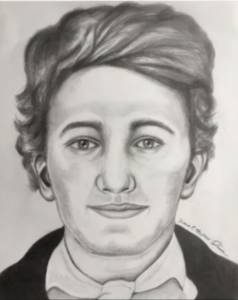
Of all the identifications announced this month, the one with the most direct resonance for West Wales is that of David Young, Boy 1st Class on HMS Erebus. He was 17 years old when he set sail. His father was also a naval sailor but was not posted to the Erebus expedition. Before joining the Franklin mission in the spring of 1845, David Young had served on a vessel called HMS Sinbad, a dockyard lighter based at Pembroke Dock, the same yard from which Erebus had been launched nearly two decades earlier.
His skeletal remains, recovered from the southwestern coast of King William Island, confirm that he was still alive after the ships were abandoned in April 1848. He survived at least part of the desperate march across the ice. The DNA used to identify him came from a living descendant of one of his brothers.
Researchers have also created a forensic facial reconstruction of David Young, working from his skeletal remains to produce a two-dimensional likeness of the teenager who left Pembrokeshire, sailed to the ends of the earth, and never came home. The reconstruction has attracted significant attention since its publication, bringing a human face to a name that had been lost in the historical record for 180 years.
“When you combine the forensic facial reconstructions with the DNA work, I think it brings people into the story in a way that they can relate to it, the general public certainly, but also the family members.”
Dr Stenton also reflected on what the identifications mean for the descendants of the men who died.
“The families of the modern-day descendants don’t really have much information about what happened to them. I think it’s very fitting that the descendants of the men who never made it home are helping to write this new chapter about the expedition.”
Back to Pembroke Dock: An Exhibition 200 Years in the Making
Two hundred years after HMS Erebus was launched from the dockyard at Pembroke Dock, the ship’s story is returning to where it began. Pembroke Dock Heritage Centre will open a new exhibition on 8 June 2026, marking the bicentenary of the ship’s launch and bringing together artefacts from the wreck for the first time in West Wales.
The items on display have been loaned by the Royal Navy Museum and include objects that have never previously been shown publicly: a bowl and dinner plate recovered from the wreck, a boot and belt buckle believed to have belonged to an officer on board, and an ointment pot. The fragility of these items, preserved for nearly two centuries in the conditions of the Arctic wreck before being raised and conserved, has required the heritage centre to invest in specialist display equipment.
“We’ve had to purchase a hermetically sealed case, which makes sure the humidity is correct because they are very delicate. To have things like a shoe worn by an officer on board HMS Erebus is incredible.”
Those words come from Tim Payne, trustee of Pembroke Dock Heritage Centre, who has been central to bringing the exhibition together. He reflected on the significance of the bicentenary connection to the town.
“Pembroke Dock launched that ship on 7 June 1826 and in 2014 it was rediscovered. I think that brings it home, that local aspect here from Pembroke Dock, and tells that wonderful history that we’ve had.”
The exhibition launch on 8 June will be attended by four living descendants of Erebus crew members, including a relative of Captain Franklin himself. A relative of David Young, the cabin boy with connections to the Pembroke Dock dockyard, will also be present. In addition, a local supporter of the heritage centre has confirmed that his great-great-great uncle was David Young, and has offered to loan the family’s Arctic Medal for display in the exhibition.
A Story That Has Never Lost Its Power to Captivate
The Franklin Expedition has fascinated historians, writers and the public for nearly 180 years. The wreck of HMS Erebus was not discovered until 2014, when Canadian researchers located it in the icy waters of northern Canada, 169 years after it set sail. The wreck of HMS Terror was found two years later. Six of the 129 sailors who died have now been identified in total: John Gregory and James Fitzjames were named in 2021 and 2024 respectively, and the four announced this month bring the confirmed total to six.
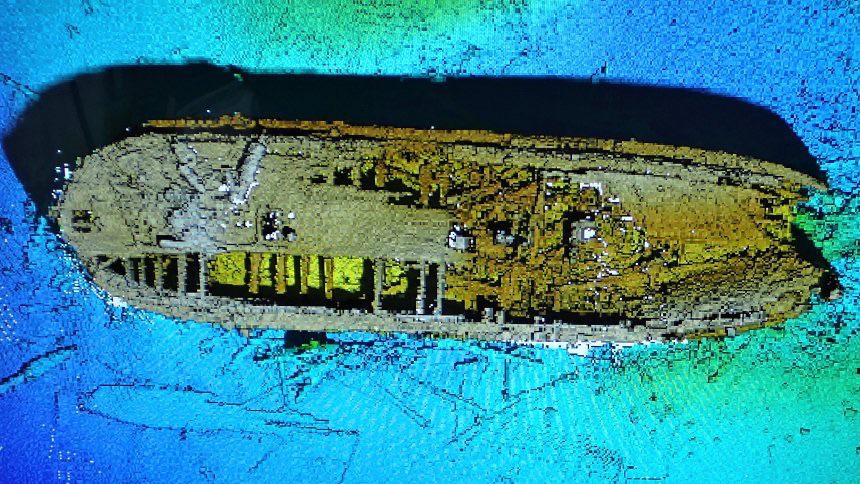
The evidence of what the survivors endured in their final weeks is harrowing. The cannibalism confirmed on some remains, the lead poisoning that may have impaired judgment, the scurvy and disease that weakened the men before they ever left the ships, and the sheer physical impossibility of the march they attempted across one of the most hostile environments on earth, all of it speaks to a catastrophe that unfolded slowly and terribly over the course of more than two years.
And yet the story retains something beyond the horror of it. These were men who left their homes and their families in pursuit of a geographical prize that had defeated explorers for generations. Some of them, including David Young, were teenagers. The cabin boy who had worked at Pembroke Dock, sailed on the ship built in his home dockyard, and died somewhere on the ice of northern Canada at the age of 17 or 18, now has a face. His descendants are coming to Pembroke Dock in June to see the exhibition.
That, as Tim Payne said, is the full circle.