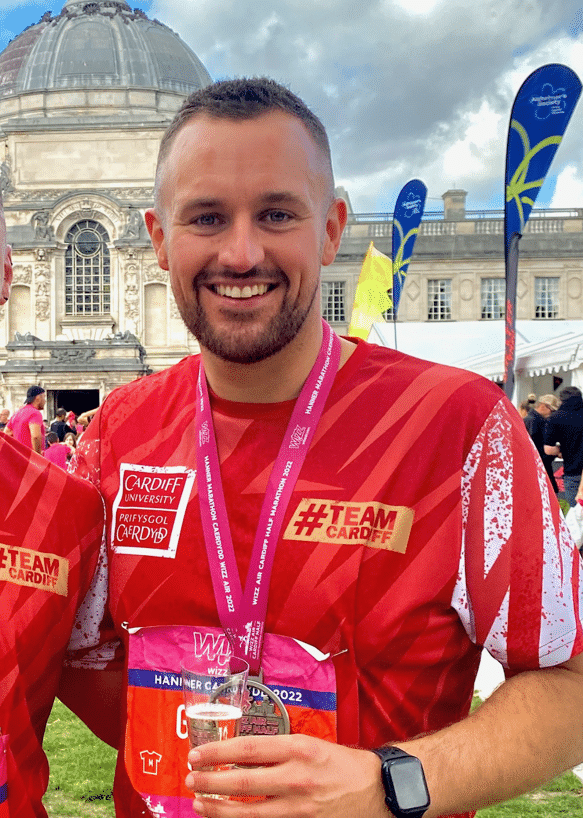
Ahead of International Men’s Day, (19th November) , Gethin Bennett, from Carmarthenshire, has shared his personal experience of mental health challenges to encourage more open conversations about men’s wellbeing and help raise awareness of the support available to those who may be struggling. His story is being shared as part of Men’s Health Awareness Month and the call to support men and boys through positive discussions around masculinity.
“Looking back several things fed into it – including wondering if what I was feeling was actually depression, telling myself brighter days were ahead. What finally made me pick up the phone was realising those excuses didn’t stack up.”
These are the experiences of Gethin Bennett, who has chosen to ‘support men and boys’ during Men’s Health Awareness Month (November) by talking about what made him reach out for support with his own mental health.
Gethin, originally from Carmarthenshire, lost his dad Alan to suicide when he was 14 and was later diagnosed with anxiety and depression.
He says: “Despite what happened to my dad, I still found it difficult to ask for help. I didn’t speak to my GP until my early 20s – I’d convinced myself that other people had it worse. But I’m super glad I did reach out because since then I’ve had counselling, I take medication regularly and I’ve found the key things that help me manage which for me are running and exercise, and having great people around me.
“Growing up in West Wales I don’t remember men talking openly about their mental health – things have definitely improved, but more still needs to be done.
“Stigma isn’t always somebody saying, “man up”. It can sound like, ‘I’m fine’ or ‘other people have it worse’, or ‘if it gets worse, then I’ll speak to somebody’. But why wait until it gets worse? You really don’t have to wait until you reach breaking point, and you don’t have to earn the right to ask for help either.”
Men’s Health Awareness Month takes place every November with a focus on mental health and the prevention of suicide in men, and of prostate and testicular cancer too.
International Men’s Day also takes place on November 19th, this year with a plea to ‘support men and boys’ and make a difference to their wellbeing by promoting positive conversations around masculinity whilst raising awareness and funds for charity.
In Wales, research shows that men account for 77% of all deaths by suicide, and that the age specific rate is highest in men aged 35-44*.
The sharing of experiences like Gethin’s has a crucial role to play in tackling stigma around mental health and in starting conversations which can support men in overcoming barriers they might be facing, and in feeling able to reach out for the support they need.
Tom Boyce, Head of Networks (Wales) at Mind Cymru, says: “We talk often about encouraging men to speak openly about their mental health, but conversations like these more often than not can only happen when men feel safe, accepted by, and connected to others.
“When people feel a sense of belonging and connection, they’re more likely to recognise when they’re struggling, speak about how they’re feeling, and to access support earlier. The power of asking twice can also be especially important – rather than leaving it at just ‘how are you?’ and saying ‘but are you really ok?’ lets the other person know you’re there and ready to listen.
“This is why events like Men’s Health Awareness month are so important in raising awareness of the barriers many men continue to face in asking for help with their mental health – and it’s why we are so grateful to people like Gethin in sharing in their own experiences for the benefit of others too.”
In Wales, there are a number of programmes run by local Minds to help support men specifically, including a cold-water swimming group in Llanelli called ‘Frozen Nutz’ and dedicated men’s groups in Haverford West and Neath Port Talbot. You can find details for your nearest local Mind here: www.Mind.org.uk/Local
If you’re finding it hard to talk to someone about their feelings, or to open up to others about your own mental health, you can also seek support in a number of ways by:
- Calling one of Mind’s Helplines or accessing information on the Mind website at www.mind.org.uk/information-support/
- Reaching out to Mind’s online community Side by Side, available 7 days a week and 24 hours a day at https://sidebyside.mind.org.uk/
- Calling Samaritans on 116 123 (freephone). Their English language line is always open and their Welsh language line opens daily from 7pm to 11pm.
- Texting SHOUT to 85258, a free 24/7 crisis text service.


