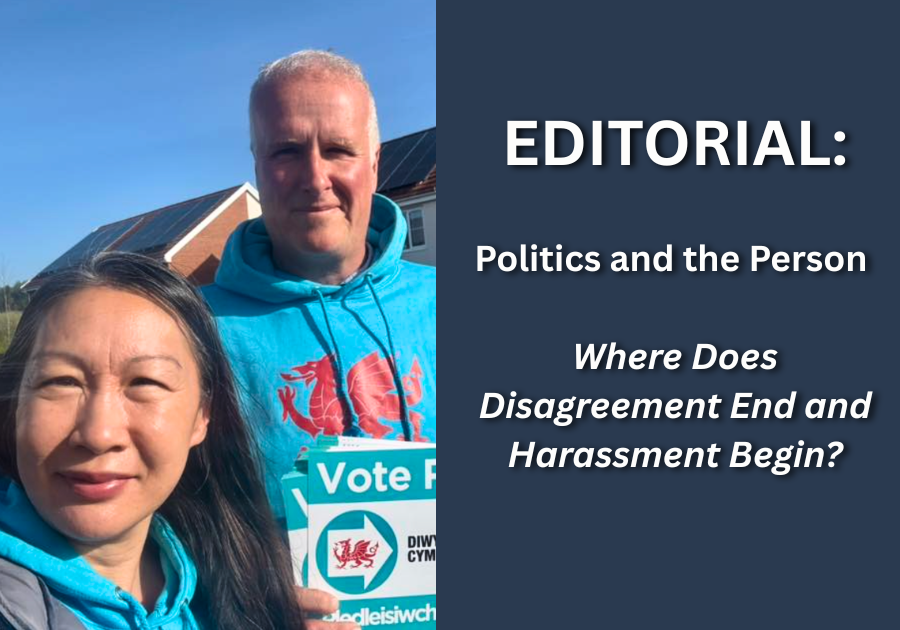
Cllr Michelle Beer (left) with MS Gareth Beer (right) on the campaign trail for the Senedd Election in April (Image / Reform UK Carmarthen Facebook)
[tta_listen_btn] The reported treatment of Llanelli councillor Michelle Beer in Carmarthen raises an uncomfortable question that cuts across every political divide: in a democracy, can we separate what someone believes from who they are? And if we cannot, what does that say about us?
On 19 May 2026, Gareth Beer, the newly elected Reform UK Member of the Senedd for Sir Gaerfyrddin, published a statement on social media describing what he said his wife, Llanelli councillor Michelle Beer, had experienced during the Senedd election campaign. He claimed she had been verbally abused in the street, chased, and called vile names, and that she had been excluded from at least one shop in Carmarthen, all of it, he said, because of her political beliefs.
Beer said he intended to visit the shop himself to seek what he called respectful dialogue. The allegations have not been tested or independently verified, and CNO has not spoken to the shop or the individuals involved. What the claims describe, if accurate, is behaviour that has no place in any version of democratic politics, regardless of which party the target belongs to or which policies they support.
It is also worth noting, for the benefit of readers who may know Michelle Beer only through the prism of Reform UK’s national politics, that her record as a local councillor includes active involvement in the campaign to secure a new school for the children of Ysgol Heol Goffa, the additional learning needs school in Llanelli. She has used her position on Carmarthenshire County Council to support that endeavour, working alongside parents and campaigners who want the school’s pupils to have the facilities they deserve. Whatever one thinks of her party, that is the work of a councillor who shows up for some of the most vulnerable children in her community.
That needs to be said plainly and without qualification before anything else is considered. Chasing a person in the street, abusing them publicly, and refusing them entry to a business because of how they vote are not acts of political opposition. They are acts of intimidation. They should be named as such, and they should be condemned as such, by everyone.
The Difficult Context
Having said that, the context in which these events occurred is not a simple one, and an editorial that ignored it would be doing its readers a disservice.
Michelle Beer is not simply a local councillor who happens to hold political views that some people in Carmarthen disagree with. She is the first Reform UK member elected to Carmarthenshire County Council, having won the Lliedi ward by-election in May 2025 with 42.6 per cent of the vote. She campaigned actively with the Llanelli branch of Reform during a period that included the Stradey Park Hotel asylum seeker controversy of 2023, a period that saw a fire at the hotel and attacks on a Labour MP’s office, and which generated significant and lasting community anger. Her husband Gareth Beer, who topped Reform’s Sir Gaerfyrddin list in the May 2026 Senedd election and became the first Reform MS elected in west Wales, has been a central figure in that political story.
None of that context justifies harassment. It does show how feelings in Carmarthen about Reform and the people who represent it run deep, particularly from the left-wing, and how the line between political opposition and personal animosity has, for some people, become blurred.
A democracy that only protects the political expression of those we agree with is not a democracy at all. That principle does not come with a party-political exception.
Where the Line Is
The question this episode forces into the open is one that communities across Britain are struggling with as political temperature rises and civic discourse coarsens: where does legitimate opposition end and unacceptable personal treatment begin?
The answer, in a democracy, is not complicated in principle, even if it is difficult in practice. Disagreeing with someone’s politics, arguing against them, voting against them, protesting against their party’s policies, writing critically about their record, these are all entirely legitimate. They are, in fact, the lifeblood of a functioning democracy. Political figures, including local councillors, enter public life with the understanding that their decisions and their associations will be scrutinised, questioned, and challenged.
What falls outside those boundaries is the treatment of a person’s everyday, private existence as forfeit because of their political choices. Following someone in the street. Screaming at them. Refusing to serve them in a shop not because of anything they have done in that shop, but because of the rosette they wore at a count three weeks ago. These things cross the line from political opposition into something else: a form of social punishment that says you are not entitled to go about your ordinary life because of how you vote or what you believe.
That is a line worth defending, not because Michelle Beer’s politics are above criticism or scrutiny, they are not, and CNO has reported critically on aspects of Reform’s record and conduct on numerous occasions, but because the alternative is a public sphere in which ordinary participation in democracy carries a social cost that most people are not willing to pay. And the people least willing to pay that cost are not, typically, the powerful. They are the people we most need to remain engaged.
The Mirror This Holds Up
There is something else worth saying here, and it is aimed not at Reform’s critics specifically but at the political culture more broadly.
The past several years in Welsh politics have been marked by a consistent pattern: political anger channelled broadly toward the institutions and decisions that generated it, but also toward the individuals who are most visibly associated with a cause. Keir Starmer, Mark Drakeford, Vaughan Gething, Eluned Morgan, Huw-Irranca Davies. A few familiar names.
The Stradey Park Hotel protests in Llanelli were not primarily about asylum policy. They were, for many of the people who turned up, about fear, frustration, and the sense of being ignored by institutions that were supposed to represent them. That anger found a target and attached itself to it. The consequences were serious.
The treatment Michelle Beer reportedly experienced in Carmarthen is a different order of event, but it belongs to the same general pattern: political anger personalised. Institutions do not blush when you shout at them. Policies do not feel shame when you chase them down the street. People do.
If the goal of those who oppose Reform is to demonstrate that their values, of openness, community, decency and respect, are genuinely superior to the politics they are opposing, then chasing a councillor through Carmarthen is a spectacularly poor way of making that argument and serves to bolster a particular narrative that the left-wing are bent on destroying democracy in favour of a ‘one boot fits all’ approach and penalising the people who don’t fit the boot.
What Civil Disagreement Looks Like
In Carmarthenshire, as elsewhere, we are going to be living with the political consequences of the May 2026 Senedd election for a number of years. Reform has representation at Cardiff Bay for the first time. Its voters, whatever we think of the party, are our neighbours, our colleagues, and in some cases our friends and family members. The question of how we disagree with each other without destroying the social fabric that makes community life possible is not an abstract one. It is immediate and it is local.
The answer is not to pretend that political differences do not matter, or that Reform’s record and conduct should not be scrutinised and challenged with vigour. They should. CNO will continue to do exactly that, taking an impartial approach each and every time. The answer is to remember that the person behind the political position is still a person, entitled to walk down a street in Carmarthen, shop where they choose, and go about their daily life without being pursued or abused.
That is not a concession to their politics. It is the basic condition of a civil society. And it is one that, if we allow it to erode in the name of aggressively opposing a political party that has the popular vote, will not be available to protect any of us when the political wind turns.
You do not defend democratic values by abandoning them selectively. You defend them consistently, even when, especially when, the person you are defending holds views you find genuinely objectionable.
This is an editorial opinion piece representing the view of the Carmarthenshire News Online editorial team. The allegations described in this piece were made by Gareth Beer MS on social media on 19 May 2026. CNO has not independently verified the specific incidents described and has approached the parties involved for comment. Carmarthenshire News Online is an independent publication not affiliated with any political party.
Carmarthenshire News Online, Independent News for Sir Gaerfyrddin | carmarthenshirenewsonline.com