A plan to strip a north Pembrokeshire faith primary school of its religious status could be dropped.
In May, Pembrokeshire County Council voted to remove the Voluntary Controlled (VC) status from Welsh-medium Ysgol Cilgerran, despite 97 per cent of consultation responses opposing the change, which the church called ‘entirely unnecessary’.
That consultation for the “discontinuation of Cilgerran Church in Wales Voluntary Controlled School and establishment of the same as a 3-11 Community School” followed a review which “considered the extent of surplus school places in the area, set against a significant decline in the pupil population,” the council has previously said.
Councillors have previously been warned the proposals were “fundamentally flawed,” with the school’s land legally in trust as a Church of Wales school, the change “essentially creating a new school with no premises to occupy”.
Hundreds opposed the changes, while a petition on the council’s website attracted 391 signatures.
The Church in Wales formally objected and warned of legal action, accusing council officers of “public misrepresentation and unqualified legal assertions” and “discrimination against faith schooling”.
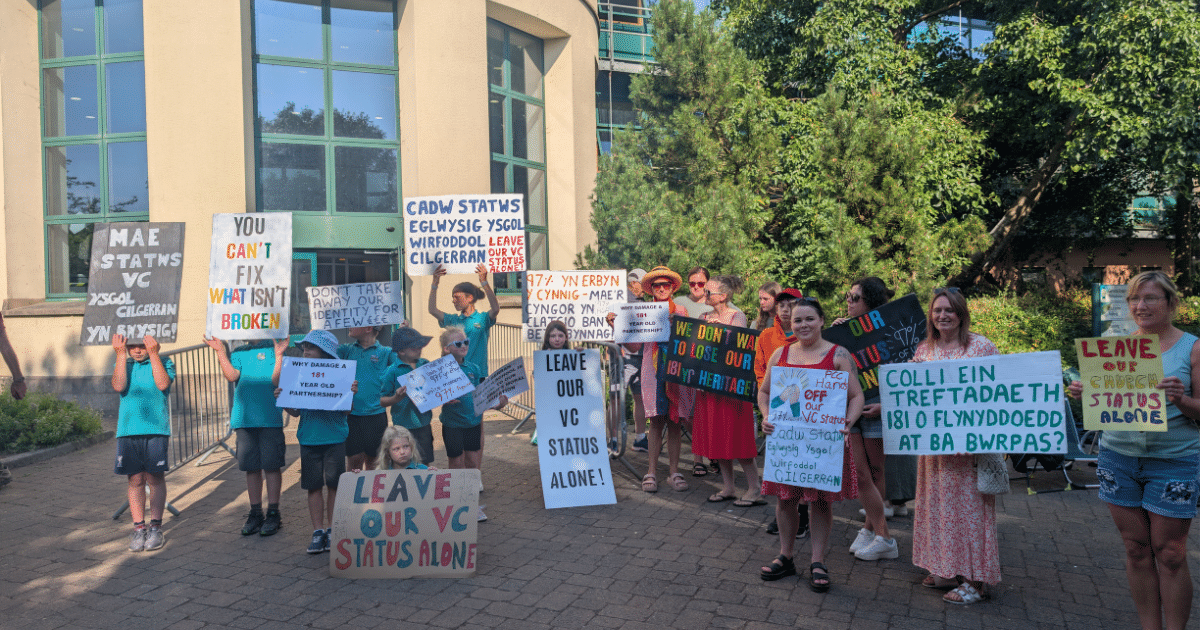
Cilgerran parents, teachers and pupils travelled to County Hall in Haverfordwest to protest at the council’s July meeting.
Their colourful, pupil-made protest signs carried messages including “You can’t fix what isn’t broken”, “Leave our VC status alone” and “Don’t take away our identity for a few £££”.
Wales Humanists backed the council’s plans, while the National Secular Society (NSS) also supported them.
The Roman Catholic Church in Wales also urged Pembrokeshire County Council to drop plans to remove Ysgol Cilgerran’s Church in Wales status.
The council published a statutory notice in June and received 91 objections, which will be presented to councillors on October 15, when a report will recommend dropping the contentious plans.
The report says the status change “gives rise to separate and potentially complex property and occupation issues”, while the diocese challenges “the council’s ability to discontinue the existing school and thereafter continue to occupy the school site for the purposes of the newly established community school”.
Councillors can continue with the plan, drop it, or make significant changes and consult again.
The report recommends dropping the plan because of serious legal questions over ending the school’s current status and occupying the site as a community school.
It says going ahead would “create a material risk that continuity of education at the existing site could not be assured during or following implementation”, while officers “do not consider it appropriate to expose pupils, parents/carers or staff to that degree of uncertainty”, especially when the plan aims to keep education at the same site.
Councillors will make the final decision on October 15.
The consultation received 203 responses, with 197 opposing the proposal and three supporting it.