[tta_listen_btn] THE 2026 Senedd election has been described by commentators as the most consequential since Welsh devolution began in 1999. For the first time, Wales is operating under a fully proportional closed-list D’Hondt system, replacing the hybrid Additional Member System used in previous elections. Sixteen enlarged super-constituencies will each return six Members of the Senedd, increasing the chamber from 60 to 96 seats. The change means, in theory, that no vote is wasted and every percentage point matters.
Nowhere is that arithmetic more sharply felt than in Sir Gaerfyrddin, the new super-constituency covering the entire county of Carmarthenshire. Formed by merging the Westminster seats of Caerfyrddin and Llanelli, it carries an electorate of approximately 145,543 people. To win even a single seat, a party or independent candidate must clear roughly 10 to 12 per cent of the vote at a 50 per cent turnout, a bar that is achievable for several parties but out of reach for others.
National polling heading into polling day puts Plaid Cymru and Reform UK locked in a near-dead heat at the top, both hovering around 27 to 28 per cent. Welsh Labour sits in third place at approximately 18 to 21 per cent, a significant retreat from its historic dominance. The Welsh Conservatives are polling around 10 to 13 per cent, the Wales Green Party at 9 to 10 per cent, and the Welsh Liberal Democrats at a marginal 3 per cent. Projections based on those figures suggest Plaid Cymru could take as many as three or four of Sir Gaerfyrddin’s six seats, with Reform UK and Labour competing for the remainder.
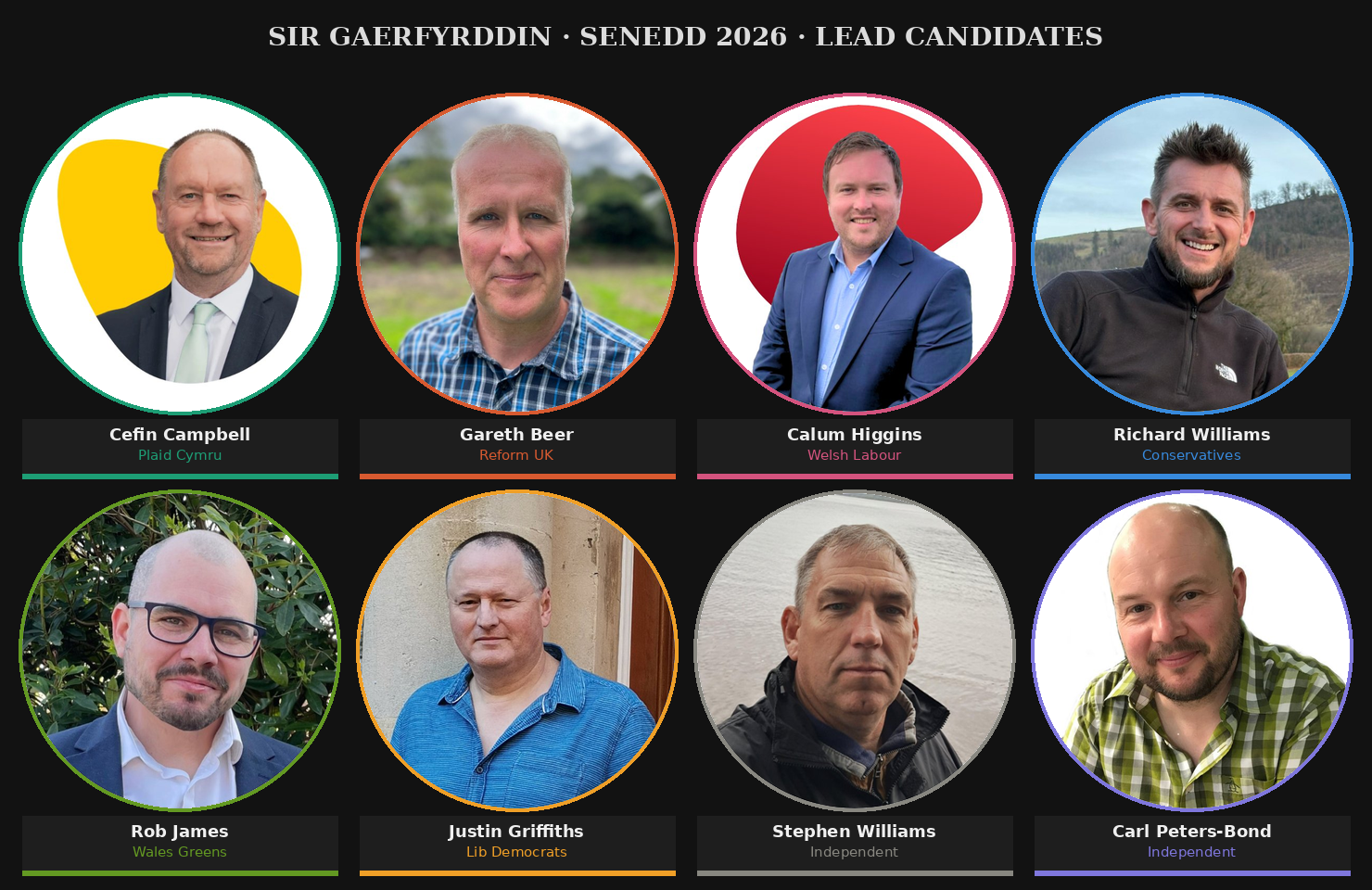
This guide profiles each of the lead candidates standing in Sir Gaerfyrddin, drawing on their public records, declared policies, electoral histories and local context. The article concludes with a section reflecting public opinion on the election as expressed across community channels, local media and canvassing reports.
All information is drawn from publicly available sources. This article does not advocate for any candidate or party.
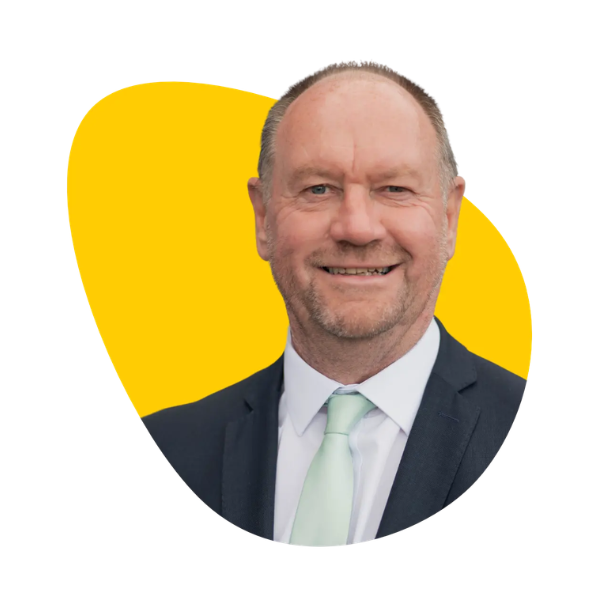
1. Cefin Campbell
Party · Plaid Cymru, ‘The Party of Wales’
Personal Background
Cefin Arthur Campbell was born in June 1958 and raised in the Amman Valley, Carmarthenshire. His roots in the county run deep: his father’s family were miners, including his grandfather, while almost all of his mother’s family were farmers. He is married with three daughters and lives near Llandeilo in the Tywi Valley. In his spare time he is a keen Scarlets and Swansea City supporter, enjoys fishing, and caravans with his family.
Campbell is a fluent Welsh speaker and has spent the majority of his professional life in the service of the Welsh language and Welsh-medium education. After graduating he taught Welsh for Adults at Swansea University before being appointed as a lecturer in Welsh Language, Literature and Welsh History at Cardiff University’s Department of Adult Continuing Education.
Career and Public Record
In 1991, Campbell left higher education to establish the very first Menter Iaith (Community Language Initiative) in Wales, Menter Cwm Gwendraeth, before going on to establish similar projects across the country. There are now 22 Mentrau Iaith operating throughout Wales, and Campbell is credited as the founder of the model. He also served as a member of the S4C Authority, acted as a language advisor to Bòrd na Gàidhlig in Scotland, and worked as a licensed inspector for Estyn, the Welsh education watchdog. In 2008 he founded Sbectrwm, a consultancy specialising in research, strategic planning, project management and training for leading Welsh organisations, which he led until his election to the Senedd.
He was first elected as a Plaid Cymru county councillor for Llanfihangel Aberbythych on Carmarthenshire County Council in 2012, retaining the seat in 2017 when he was also appointed to the Cabinet as Executive Board Member for Communities and Rural Affairs. During his time on the cabinet he led a cross-party group developing a comprehensive Welsh language strategy for the council, a rural regeneration plan, a poverty reduction action plan, and a net-zero carbon roadmap targeting 2035. He served until his election to the Senedd in May 2021.
Since his election as MS for Mid and West Wales in 2021, Campbell has served as Plaid Cymru’s spokesperson for Rural Affairs and Agriculture, and from January 2022 to May 2024 was one of the Designated Members under Plaid Cymru’s Co-operation Agreement with the Welsh Government. In that role he was partly responsible for securing free school meals for all primary school children in Wales, legislation to tackle the second homes crisis, the drafting of the Welsh Language and Education Bill, and the establishment of Welsh history as a mandatory part of the national curriculum. Since May 2024 he has held the party’s education portfolio.
Senedd MS since: May 2021 (Mid and West Wales regional list)
County councillor: 2012–2021, Carmarthenshire County Council
List position: 1st — Plaid Cymru
Key Policies for Carmarthenshire
Campbell’s published platform for Sir Gaerfyrddin centres on what he describes as a ‘radical but feasible’ vision. He has called for a fair funding settlement for Carmarthenshire, pointing to a disparity in the 2025–26 Welsh Budget in which Cardiff Council received a 5.3 per cent uplift while Carmarthenshire received only 4.2 per cent. On the Welsh language he advocates for universal Welsh-medium provision for all children as a long-term goal, building on the Welsh Language and Education Bill. He supports sustainable farming and environmental land management over intensive agriculture, and is a proponent of local ownership of renewable energy, including the Celtic Sea offshore wind programme. He backs Plaid Cymru’s ‘Cynnal’ child benefit payment and expanded childcare provision. Welsh independence remains a stated long-term goal of the party, though Plaid leader Rhun ap Iorwerth has ruled out holding a referendum in a first term of government.
“Sir Gaerfyrddin is written on my heart. I will be taking Plaid Cymru’s message to every corner of this county, with all of my energy and determination.” — Cefin Campbell
Strengths and Weaknesses
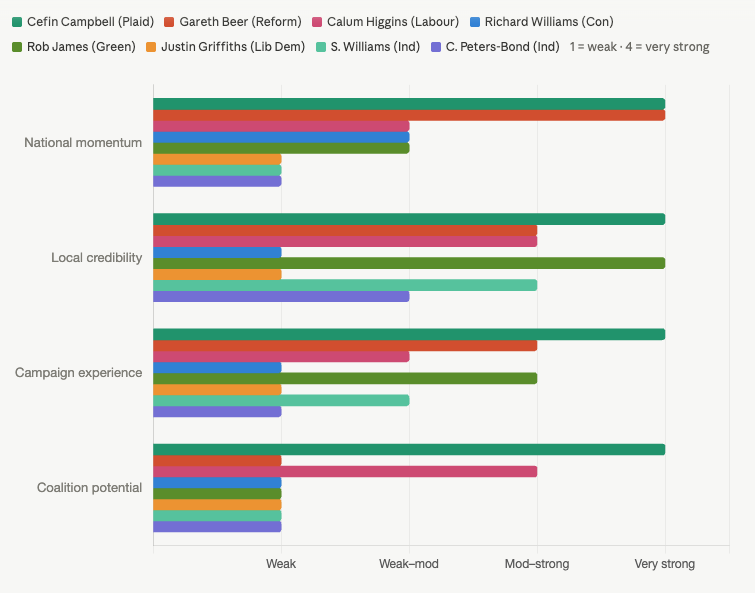
Campbell is widely regarded as the frontrunner in Sir Gaerfyrddin and arguably the strongest candidate across all dimensions in the constituency. He brings sitting MS experience, deep Carmarthenshire roots, a decade on the county council, executive cabinet experience, and a track record of legislative achievement at the Senedd. Plaid Cymru’s national polling positions him to lead a dominant performance in the county, analysts project the party could take three or four of the six available seats. On coalition potential, Plaid is the most likely party to lead the next Welsh Government, meaning Campbell would enter the Senedd with real leverage in Cardiff Bay. The principal risk is that Plaid’s national poll lead narrows between now and polling day, or that a lower-than-expected turnout in Carmarthenshire limits the party’s seat haul.

2. Gareth Beer
Party · Reform UK Wales
Personal Background
Gareth Beer was born in Pontypool and has lived in the Llanelli constituency for more than 20 years. He is a small business owner and tradesperson, a father of four, and a Kidwelly Town Councillor. He also serves as a Community Hall Committee Trustee and is Reform UK’s Carmarthenshire Branch Chairman. He founded his own business in 2006 providing support and accommodation for young people alongside construction services. His wife, Michelle Beer, holds a postgraduate qualification in Law and Business and was elected in May 2025 as the county’s first-ever Reform UK councillor after winning the Lliedi ward by-election in Llanelli, a seat that had been a Labour stronghold.
Career and Public Record
Beer has contested elections in Carmarthenshire since 2021, when he stood for the then-Brexit Party (now Reform UK) in the Llanelli Senedd constituency, finishing fifth with 672 votes. His trajectory since then has been one of the sharpest rises in local Welsh politics. In the July 2024 UK general election, standing in the new Llanelli Westminster constituency, he secured 11,247 votes, just 1,504 behind the Labour incumbent, Nia Griffith, who had held the seat since 2005. That result represented Reform UK’s strongest performance anywhere in Wales in the 2024 general election. His wife’s by-election victory in the Lliedi ward in May 2025 further consolidated the family’s political footprint in Llanelli.
Beer has been a prominent voice in Carmarthenshire on issues including NHS waiting times, the cost of living, and immigration. He was one of the community figures involved in opposition to the proposed use of the Stradey Park Hotel as asylum seeker accommodation in 2023, a campaign that ultimately saw the Home Office withdraw the plans. He campaigns extensively on the doorstep and his team reported all six Reform candidates were actively canvassing across the county in the weeks before polling day.
2024 Llanelli result: 11,247 votes — 2nd place, 1,504 votes behind Labour
Reform UK role: Carmarthenshire Branch Chairman
List position: 1st — Reform UK Wales
Key Policies for Carmarthenshire
Beer and the Reform UK Wales manifesto prioritise NHS reform, pledging to dramatically reduce waiting lists through structural change. On the economy, the party proposes a 1p cut in the basic rate of income tax and support for small businesses. Reform UK opposes net zero energy policies, rejecting what it describes as ‘damaging net zero ideology that threatens jobs, energy security and the countryside.’ The party supports scrapping the Nation of Sanctuary initiative, reversing the 20mph default speed limit, building the M4 Relief Road as a toll road, abolishing Natural Resources Wales, and placing a moratorium on new onshore wind farms. Reform UK also proposes that local people in Wales be prioritised for social housing.
“Our challenge between now and polling day is simple: speak to as many voters as possible. People genuinely want to talk to us and we are eager to listen.” — Gareth Beer
Strengths and Weaknesses
Beer is the most electorally battle-tested candidate on the Reform ticket in Wales. His near-miss in Llanelli in 2024 demonstrated a capacity to mobilise a significant vote share in a Labour stronghold, and the party’s national polling at approximately 27 to 28 per cent in Wales gives him a realistic chance of returning multiple seats in Sir Gaerfyrddin. His local credibility is bolstered by two decades of Carmarthenshire residency, business ownership, a Kidwelly council seat, and his wife’s elected position. His campaign organisation is demonstrably active. The principal weaknesses are structural: both Labour and Plaid Cymru have explicitly ruled out any post-election co-operation with Reform, which limits his leverage in government even if he wins a seat. Reform UK has also faced national-level controversy during the campaign, including the resignation of a candidate over a published photograph, and ongoing internal disputes about candidate selection in other constituencies.

3. Calum Higgins
Party · Welsh Labour
Personal Background
Calum Higgins is a lifelong resident of Tycroes, near Ammanford, in the heart of Carmarthenshire. He is a fluent Welsh speaker and was selected by Labour members to top the party’s closed list in Sir Gaerfyrddin in November 2025. He currently serves as Deputy Mayor of Ammanford and sits on both Ammanford Town Council and Lliedi Community Council. He trained as a barrister and has worked as a Citizens Advice lawyer, representing people during the austerity years. He subsequently moved into the trade union sector, working as a manager and policy officer for an NHS health trade union and representing members across Wales during the Covid-19 pandemic.
Career and Public Record
Higgins is a first-time Senedd candidate. His professional background spans legal advice, public policy and health sector trade unionism, experience he has cited as directly relevant to the challenges facing Carmarthenshire, from NHS waiting lists to the cost-of-living crisis. He was selected ahead of several other Labour candidates in a competitive internal process, with party members backing him to lead the list. His campaign has emphasised local accountability and what he describes as the need to ensure that national Labour policies in both Cardiff Bay and Westminster actually deliver for communities in the county. He has criticised the Welsh Conservative record on public services and positioned Reform UK as a threat to the NHS and welfare state.
Labour has launched its campaign in the county with full awareness of how dramatically the political landscape has shifted. Polling suggests the party faces the real possibility of failing to win any of the six seats in Sir Gaerfyrddin, a county it once dominated at Senedd level. The party held the Llanelli Senedd seat from 2011, having previously lost it twice to Plaid Cymru’s Helen Mary Jones. It also held the Carmarthen East and Dinefwr seat for much of the devolution era. Under the new proportional system, however, Labour would need to retain approximately 18 to 21 per cent of the vote county-wide to secure even one seat.
Occupation: Barrister; Citizens Advice lawyer; NHS trade union manager/policy officer
Current roles: Deputy Mayor of Ammanford; Town and Community Councillor
List position: 1st — Welsh Labour
Key Policies for Carmarthenshire
Labour’s Carmarthenshire campaign has focused on defending and expanding public services, with Higgins calling for a fair deal for the county’s children in particular. On health, the Welsh Labour manifesto proposes spending £4 billion to build hospitals of the future, with pressing medical needs seen within 48 hours. The party has pledged a freeze on Welsh income tax rates, free school meals extended to secondary school pupils in receipt of Universal Credit, 20,000 new childcare spaces, and 100,000 new homes over the next Senedd term. Labour also supports the Welsh language and emphasises its commitment to the Nation of Sanctuary programme, in direct contrast to both Reform UK and the Conservatives.
“I want to represent Sir Gaerfyrddin to make a difference on the ground, ensuring national policies deliver for our communities.” — Calum Higgins
Strengths and Weaknesses
Higgins brings genuine local roots, professional credibility and fluency in Welsh, assets that matter in a bilingual county. His trade union and legal background gives him a substantive policy foundation, and Labour’s brand still carries weight in parts of the constituency, particularly in Llanelli and the Amman Valley. His coalition potential is also notable: Labour has left open the door to a co-operation arrangement with Plaid Cymru after the election. The significant weaknesses are external rather than personal. Labour’s national polling in Wales has retreated sharply, and the party faces a two-front squeeze, from Plaid on the left and Reform on the right. Higgins is a first-time Senedd candidate with limited campaign experience at this level. Analysts suggest one seat for Labour in Sir Gaerfyrddin is possible but far from certain.

4. Richard Williams
Party · Welsh Conservative and Unionist Party
Personal Background
After serving his country for nearly 12 years in the armed forces, Richard built a career as a plumber and gas engineer before moving into education, where he now teaches his trade at a local college, passing on practical skills to the next generation of Welsh workers.
With six years of community coaching experience across both rugby union and rugby league, Rich is passionate about developing young players and keeping communities active and connected. He also has deep personal ties to the farming communities of Carmarthenshire and understands the pressures facing rural Wales.
Rich is campaigning on cutting the cost of living, bringing jobs and investment back to local communities, standing up for the NHS, delivering free dental treatment for school-age children, removing interest on student loans, and bringing back youth clubs to give young people safe, positive spaces in their communities.
“I served my country. Now I want to serve Carmarthenshire.” – Richard Williams to Carmarthenshire News Online
Career and Public Record
Williams has contested three Carmarthenshire local by-elections for the Conservative Party. In March 2024 he stood in the Elli ward by-election in Llanelli, finishing second of eight candidates with 151 votes, his strongest result to date. In March 2025 he stood in the Llanddarog by-election, finishing third of four candidates with 139 votes. In May 2025 he stood again in the Lliedi ward by-election, finishing fifth of eight candidates with 93 votes. He has not held elected office. He has not published a policy statement on his candidate profile page. The Welsh Conservative Party’s Wales manifesto, titled ‘Fix Wales,’ provides the substantive platform he is standing on.
Elli by-election (Mar 2024): 151 votes — 2nd of 8
Llanddarog by-election (Mar 2025): 139 votes — 3rd of 4
Lliedi by-election (May 2025): 93 votes — 5th of 8
List position: 1st — Welsh Conservatives
Key Policies for Carmarthenshire
Williams is standing on the Welsh Conservatives’ ‘Fix Wales’ manifesto, launched by party leader Darren Millar in March 2026. Key commitments include a 1p cut in the basic rate of income tax in Wales, saving the average working family approximately £450 per year; scrapping business rates for small firms; re-establishing the Welsh Development Agency; delivering the M4 Relief Road; returning to a 30mph national default speed limit; and reversing the 20mph speed limit introduced by the Welsh Government. On education the party proposes tuition fee refunds for nursing, medical, teaching and dentistry graduates who study in Wales and go on to work in the Welsh NHS or Welsh schools for at least five years, plus 125,000 apprenticeships over the next Senedd term. On health the manifesto pledges to declare a health emergency and cut waiting times. The party also commits to scrapping the Nation of Sanctuary initiative.
Strengths and Weaknesses
The Welsh Conservative position in Sir Gaerfyrddin is entirely dependent on the party’s national brand rather than the individual profile of its lead candidate. With the Conservatives polling at approximately 10 to 13 per cent in Wales, one seat in the constituency is arithmetically within reach. However, Williams’s track record, three by-election attempts with no victories and a declining vote tally across the sequence, provides little indication of personal electoral strength. The party faces a severe squeeze from Reform UK, which is targeting the same right-of-centre voter base with a more aggressively populist offer. The complete absence of a public-facing candidate profile or policy statement is also an unusual feature for a lead candidate. If the Conservative vote holds above the D’Hondt threshold, Williams would enter the Senedd largely on the coat-tails of the national result rather than on personal mandate.

5. Rob James
Party · Wales Green Party
Personal Background
Robert (Rob) James lives in Llanelli and has deep roots in the community. He is married and represented the Lliedi ward in Llanelli on Carmarthenshire County Council, a seat he continues to hold. By some accounts he was the youngest Labour group leader in Wales, having led the Labour group on Carmarthenshire County Council before his suspension by Welsh Labour in 2024. His family and professional background are firmly embedded in Llanelli.
Career and Public Record
James’s political journey has been one of the most publicly discussed in Welsh local politics in recent years. He first served as a Labour county councillor and rose to become Labour Group Leader on Carmarthenshire County Council. In 2024 he was suspended by Welsh Labour and subsequently sat as an independent councillor. In November 2025 he made a high-profile defection to the Wales Green Party, announced at the party’s Wales conference in Cardiff. He has been described as the first sitting Welsh councillor to join the Greens from Labour, a move that generated significant media coverage and was positioned by the party as a signal of its growing presence in Welsh community politics.
During his time in local government he led campaigns to divest Carmarthenshire’s pension fund from fossil fuels, championed a locally owned bus company for school pupils, and opposed cuts to public services. His defection was framed as a principled choice to pursue more radical action on inequality and the environment. He continues to serve as a county councillor for Lliedi ward at the time of writing.
Former role: Labour Group Leader, Carmarthenshire County Council
Current role: County Councillor, Lliedi Ward, Llanelli
National polling (Greens): ~9–10% Wales-wide
List position: 1st — Wales Green Party
Key Policies for Carmarthenshire
James is standing on the Wales Green Party platform, which includes public ownership of water companies to lower bills; rent controls; net zero by 2030 through renewable energy; free public transport for under-21s; 12,000 high-standard social homes; and standing up for international law. The party supports Welsh independence as a long-term goal. On local issues James has pledged to hold Welsh Water to account over sewage discharge into local rivers and to champion green jobs in the Llanelli area, particularly linked to the Celtic Sea offshore wind development. He has condemned Labour’s immigration reforms as echoing, in his words, ‘old BNP policy,’ a comment that attracted significant attention and controversy. He advocates strongly for free university fees, Welsh-medium expansion, and tackling inequality in educational attainment.
“His defection from Labour adds credibility and media visibility. A local surge, plausible given his profile, could put a seat within reach.” — Electoral analysis, Senedd 2026 Candidate Spotlight
Strengths and Weaknesses
James is one of the most locally credible candidates in the field. He was born and raised in Llanelli, has held elected office on the county council, led community campaigns, and his high-profile defection story gave him more media coverage than any other Green candidate in Wales. His strongest dimension is local credibility. On campaign experience he is more than competent, having led a Labour group and managed community political campaigns over several years. The principal weakness is the national polling position: 9 to 10 per cent for the Greens nationwide sits right at the estimated D’Hondt threshold for a seat in Sir Gaerfyrddin, borderline at best. A local surge above the national average is the scenario the party requires. Coalition potential is limited; his public break with Labour is unambiguous, and the Greens hold no current Senedd seats from which to negotiate.
6. Justin Griffiths
Party · Welsh Liberal Democrats
Personal Background
Justin Mark Griffiths lives in his hometown of Llanelli. He is married with two sons from a previous marriage. After graduating from Aston University with a degree in chemical engineering, he worked for 27 years at British Steel (TATA), spending 25 of those years at the Port Talbot site. He was made redundant in 2016 at the age of 50. He has spoken openly in his public statements about the personal and financial impact of that redundancy, drawing a parallel with the experience of steelworker communities in the Aberavon area following the closure of the blast furnaces. In his spare time he walks two rescue dogs, undertakes DIY and plays golf occasionally.
Career and Public Record
Griffiths became involved with the Liberal Democrats after his retirement, having previously been unable to commit to political activity due to work and family commitments. His electoral record across multiple contests shows consistent participation but limited electoral success. He stood in the Dafen and Felinfoel ward in the 2022 Carmarthenshire local elections, finishing eighth of eight candidates with 51 votes. In the March 2024 Elli by-election in Llanelli he finished seventh of eight candidates with 16 votes. In the May 2024 Dyfed-Powys Police and Crime Commissioner election he finished fourth of four candidates with 7,719 votes. In the July 2024 Aberafan Maesteg Westminster election he finished sixth of eight candidates with 916 votes. In the August 2025 Llangennech local by-election he finished fourth of six candidates with 26 votes.
2022 Dafen & Felinfoel: 51 votes — 8th of 8
2024 Elli by-election: 16 votes — 7th of 8
2024 Westminster (Aberafan Maesteg): 916 votes — 6th of 8
Lib Dem national polling (Wales): ~3%
List position: 1st — Welsh Liberal Democrats
Key Policies for Carmarthenshire
Griffiths stands on the Welsh Liberal Democrat platform, which includes a GP appointment within seven days (or 24 hours for urgent cases), achieved through recruiting and training more GPs. On education the party proposes above-inflation school funding every year and a mental health professional in every school. The manifesto supports freezing rail fares and simplifying ticketing, completing rail electrification, and implementing a windfall tax on oil and gas super-profits. On climate the party targets net zero by 2045 with 80 per cent of UK electricity generated from renewables by 2030. The Lib Dems also support scrapping what they describe as the Conservatives’ hostile environment immigration strategy. On democracy the party advocates replacing first-past-the-post with the Single Transferable Vote.
Strengths and Weaknesses
Griffiths’s personal story, redundancy at 50 from a Welsh steel plant, an engineering career, a genuine connection to Llanelli, is relatably rooted. However, his electoral record tells a consistent story of finishing near the bottom of competitive fields, and the Welsh Liberal Democrats’ national polling at approximately 3 per cent in Wales places the party far below the threshold needed to win even a single seat under D’Hondt in Sir Gaerfyrddin. There is no realistic path to a seat on current numbers, and no coalition leverage to speak of even in the hypothetical event of one being won. Griffiths represents a party that in Wales holds one Senedd seat, held on the regional list, and has struggled to build the kind of local infrastructure that produces elected members.

7. Stephen Williams
Status · Independent Candidate
Personal Background
Stephen Williams, known locally as Steve, is 55 years old and lives in New Road in the Elli ward of Llanelli, at the heart of the community he represents. He is a retired police officer having served with Dyfed-Powys Police for more than 30 years in a variety of roles, including on high-profile cases. He retired in 2019 and has since been an active member of Furnace United RFC.
Career and Public Record
Williams’s entry into elected politics came in March 2024, when he stood as an independent in the hotly contested Elli ward by-election in Llanelli, beating seven other candidates including representatives from Plaid Cymru, Labour, the Liberal Democrats and UKIP. It was his first time standing for election. He won seats on both Llanelli Town Council and Carmarthenshire County Council. The by-election was fought in the context of significant local debate about the town centre and, prominently, the campaign against the use of the Stradey Park Hotel as asylum seeker accommodation. Williams had been one of the leading voices in that campaign, representing the community at three High Court hearings in London and holding the Home Office to account over its due diligence. The Home Office ultimately withdrew the plan in October 2023.
2024 Elli by-election: 211 votes — 1st of 8 candidates
Current roles: County Councillor and Town Councillor, Elli ward, Llanelli
Status: Independent — no party affiliation
Stance and Platform
Williams has published a manifesto through his Facebook campaign page setting out positions across six policy areas. His platform is pragmatic and community-focused, avoiding rigid ideological framing in favour of practical local priorities.
On education he calls for a review of the PLASC school funding system to ensure schools receive fair allocations, proper reflection of the real cost of Additional Learning Needs, and less bureaucracy for headteachers and staff. He has made swimming lesson access a signature commitment, described in his materials as “a life-saving skill, not a luxury,” proposing universal provision for every child in partnership with Welsh Government, local authorities and Dŵr Cymru, with targeted support for children from low-income backgrounds.
On farming he backs a review of the Sustainable Farming Scheme to make it workable for Welsh farmers, improved farm gate payments, reduced bureaucracy, and increased use of Welsh produce across schools, hospitals and public services. He also calls for stronger mental health and NHS support for the farming community. On health he advocates reviewing NHS funding for practical effectiveness, increasing the number of GPs, consultants and specialists through training and bursaries, reducing waiting lists, and ensuring fair healthcare access regardless of where people live in Wales.
His transport priorities include pushing for the Newport Bypass and improved local roads funding, with a commitment to challenging what he describes as wasteful or “vanity” spending. On the local economy he proposes changing procurement rules so that Welsh public money stays in Wales, supporting local businesses and supply chains, and developing Llanelli as a leisure destination. He also commits to challenging empty properties and absentee ownership. On community support he pledges to ensure vulnerable people have fair access to services, continue work supporting Deaf communities and NHS access, and support armed forces veterans including tackling homelessness.
His campaign slogan: “a voice that represents you, your family, your community, and not a party” encapsulates the independent identity he has built since winning the Elli ward in 2024. His known positions from that campaign, including his high-profile role in opposing the use of the Stradey Park Hotel as asylum seeker accommodation, remain part of his public record, though his published manifesto focuses predominantly on service delivery, local economic priorities and community welfare rather than immigration.
Strengths and Weaknesses
Williams is the stronger of the two independent candidates in this race. He is the only independent with a demonstrated ability to beat party candidates in a competitive Llanelli ward, a meaningful distinction. His Stradey Park campaign gave him real public visibility and a media profile that most council-level independents do not have. On local credibility and campaign experience he ranks above all other non-party candidates. The fundamental structural problem, however, is the D’Hondt system itself: a solo independent requires approximately 10 to 15 per cent of the constituency-wide vote to win a Senedd seat. Translating ward-level recognition in Elli into constituency-wide support across the whole of Carmarthenshire, from Llandovery to Ferryside, from Ammanford to Kidwelly, is a challenge of an entirely different magnitude. No coalition leverage is available if a seat were somehow won.

8. Carl Peters-Bond
Status · Independent Candidate
Personal Background
Carl Peters-Bond was born in Carmarthen and grew up in Argoed Crescent, Trimsaran, the son of a miner. His wider family has deep roots in Carmarthenshire’s farming communities, with dairy farms in Idole and Pontantwn. He attended Ysgol Trimsaran and Glan y Môr Comprehensive in Burry Port. He has dyslexia, which he has spoken about openly, and developed a strong early interest in science, technology and engineering. He began work at 12 years old on a pet stall in Llanelli market, and as a teenager set up his own aquarium cleaning business before embarking on what became his life’s work: medical leech farming. He remains the only medical leech farmer in the United Kingdom, with more than 35 years in the trade. He has been married to his husband Chris for 17 years; they were one of the first couples in Llanelli to enter into a civil partnership and later married at Llanelli Old Town Hall. He currently lives in Mynyddygarreg, near Kidwelly.
Career and Public Record
Peters-Bond has served as an independent councillor on Kidwelly Town Council for seven years. He has been Mayor of Kidwelly for four successive years, a record he describes as the longest continuous mayoral term in over 400 years of the town’s history, and holds the position at the time of writing. He has no prior history of contesting elections beyond his Kidwelly council service and has never been a member of any political party. His campaign website is carlpetersbond.wales and his campaign slogan is ‘people, not party politics.’
Kidwelly Town Council: Independent councillor, 7 years
Mayor of Kidwelly: Four successive terms — longest continuous term in 400+ years
Status: Independent — never been a party member
Stance and Platform
Peters-Bond’s declared platform centres on small government, less bureaucracy, stronger schools, thriving market towns, and genuine community engagement. He advocates for practical, people-focused politics free from party agendas. He has stated his belief in markets as the heart of communities and has personal experience of Llanelli market, having worked there as a child. His manifesto is non-ideological, emphasising listening and acting on what residents actually raise rather than imposing a predetermined agenda.
Strengths and Weaknesses
Peters-Bond is a genuinely distinctive candidate with a compelling personal story: working-class mining family roots, entrepreneurial spirit, civic commitment, and four years as town mayor. His openness about his dyslexia and his unconventional career add a human dimension rarely seen in electoral politics. His local credibility within Kidwelly and the surrounding area is real. However, Kidwelly is a small community, and his name recognition does not extend meaningfully across the breadth of a constituency that encompasses both Llanelli and Carmarthen. He has no record of having contested a competitive election at county or constituency level. The structural challenge is the same as for Stephen Williams: reaching 10 to 15 per cent across the whole of Carmarthenshire as a solo independent is, on any reasonable analysis, beyond current reach.
The Bigger Picture: What the Polls Say
As polling day approaches, the national picture in Wales is defined by an unusually fluid multi-party race. The five-poll moving average heading into April 2026 shows Plaid Cymru on approximately 28 per cent, Reform UK on approximately 28 per cent, Welsh Labour on approximately 18 per cent, the Welsh Conservatives on approximately 10 per cent, the Wales Green Party on approximately 9 per cent, and the Welsh Liberal Democrats on approximately 3 per cent.
Applied to Sir Gaerfyrddin under the D’Hondt method, those figures, if replicated locally, would broadly suggest Plaid Cymru taking three seats, Reform UK taking two seats, and Labour one seat. The Greens, Conservatives, Lib Dems and independents would all fall short of the threshold. However, Sir Gaerfyrddin is not a uniform constituency: Llanelli’s more urban, working-class character differs markedly from the Welsh-speaking rural heartlands around Llandeilo and the Tywi Valley. Local variation could shift outcomes significantly.
Analysts note that Plaid Cymru’s vote may be particularly concentrated in Sir Gaerfyrddin, given the constituency’s strong Welsh-speaking communities and historically Plaid-leaning rural areas. Reform UK’s support, conversely, may be skewed toward the more urban, English-speaking precincts of the constituency. Labour’s performance will depend heavily on whether its traditional voter base in Llanelli holds or migrates further toward Reform.
One structural feature of the new D’Hondt system deserves emphasis for voters: because this is a closed party list, you vote for a party rather than an individual. The candidates are elected in the order they appear on their party’s list. This means that a vote for Plaid Cymru in Sir Gaerfyrddin is, primarily, a vote for Cefin Campbell, and secondarily for Nerys Evans, Adam Price, Mari Arthur and the rest of the list in descending order as seat allocations are made
Voices from the County: What the Public Is Saying
Across canvassing reports, local media coverage, social media discussion and community meetings, a series of recurring themes have emerged from voters across Sir Gaerfyrddin in the weeks leading up to polling day. The following reflects a synthesis of publicly expressed opinion from identifiable sources, it does not represent a formal opinion poll and should not be read as one.
The NHS and Waiting Times
By a considerable margin, health service waiting times are the issue raised most frequently on doorsteps across the constituency. Residents in both urban Llanelli and rural Carmarthenshire have described lengthy waits for outpatient appointments, GP access, and mental health services. Frustration is expressed across the political spectrum, though voters differ sharply on who is responsible and what the solution should be. Reform UK’s local campaign reports that the NHS is the first issue raised in a majority of voter conversations. Labour candidates point to Westminster funding cuts under the previous Conservative government as the underlying cause. Plaid Cymru emphasises the need for a structural shift in how Welsh health services are funded and organised.
The Cost of Living
Energy bills, food prices and housing costs feature prominently in voter conversations. In Llanelli in particular, where household incomes have historically been below the Welsh average, the cost-of-living squeeze is described by canvassers across parties as acute. The closure of the Stradey Park Hotel and the loss of associated jobs is also cited by some residents as emblematic of broader economic vulnerability in the town. Several voters have expressed sympathy for Gareth Beer’s position on energy costs, while others have pointed to Rob James’s advocacy for rent controls and water company public ownership as addressing issues they feel directly.
Welsh Language and Identity
In the rural Carmarthenshire heartlands, particularly the communities of the Tywi and Amman valleys, the Welsh language remains a significant political issue. Voters in these areas consistently express support for Cefin Campbell, citing his track record on Welsh-medium education and his Amman Valley roots. Some have noted that the new proportional system means their vote will count in a way it did not previously, when these communities were in safe Labour or Plaid single-member constituencies where one-party dominance made their individual choice less consequential.
Immigration and the Stradey Park Legacy
The Stradey Park Hotel controversy continues to generate strong feelings in parts of Llanelli. Voters who were involved in or sympathetic to the campaign against asylum seeker accommodation at the hotel have gravitated toward candidates who took visible stances on the issue — notably Stephen Williams (the independent elected in its aftermath) and Gareth Beer (who was involved in the campaign). Some in this voter group have indicated they will vote Reform UK, while others remain undecided between Reform and voting for Williams personally as an independent. Michelle Beer’s by-election victory in the Lliedi ward in 2025 is cited by Reform supporters as evidence that the political shift in Llanelli is real and not temporary.
First-Time Voters and Young People
The lowering of the voting age to 16 for Senedd elections means a cohort of young voters is participating for the first time. Canvassers from several parties report that young voters in Carmarthenshire show particular interest in climate policy, housing affordability and the Welsh language. Rob James’s profile, as a younger, high-profile defection candidate focused on green issues and rent controls, appears to resonate with some in this demographic. Plaid Cymru’s youth-oriented pledges on childcare and the Cynnal child benefit payment have also been noted as popular with young families.
Voter Attitudes to the New Electoral System
A recurring theme across public discussion is uncertainty or confusion about how the new voting system works in practice. Many voters are accustomed to voting for a named individual rather than a party list. Local community meetings and voter information events have sought to address this, with varying success. Some voters have expressed frustration that under the closed list system they cannot choose between candidates within a party, for example, voting for one named Plaid Cymru MS over another. Others have welcomed the proportionality of the new system, particularly those in communities that have historically felt their votes were ‘wasted’ under the previous arrangement.
A Constituency Watching Wales
Perhaps most striking in canvassing reports from across Sir Gaerfyrddin is a sense that voters are aware this is an election of genuine consequence, for Wales, not just for the county. Whether the Senedd will be led by Plaid Cymru, by a Labour-Plaid arrangement, or whether Reform UK can translate its polling strength into government influence, these are questions being discussed in Carmarthenshire pubs, community halls, school gates and rugby clubs in a way that participants say feels different from previous devolved elections. The expanded Senedd, the new voting system, and a genuinely competitive multi-party race have combined to create conditions for a level of democratic engagement that the county has rarely, if ever, seen in the context of Welsh politics.
“This time my vote actually counts. I’ve been voting in Senedd elections for 20 years and this is the first one where I feel like it matters.” — Llanelli voter, quoted in canvassing reports, April 2026