[tta_listen_btn] Wales is sixteen days away from the most consequential Senedd election since devolution began in 1999, and the latest polling shows a race so tight that the outcome is genuinely anyone’s to call.
A YouGov MRP model commissioned by ITV Cymru Wales and Cardiff University, with fieldwork carried out between 6 and 15 April, puts Reform UK and Plaid Cymru both on 29% of the vote. Under the new D’Hondt proportional representation system that Wales is using for the first time, that dead heat in vote share translates, by the narrowest of margins, into a one-seat lead for Reform.
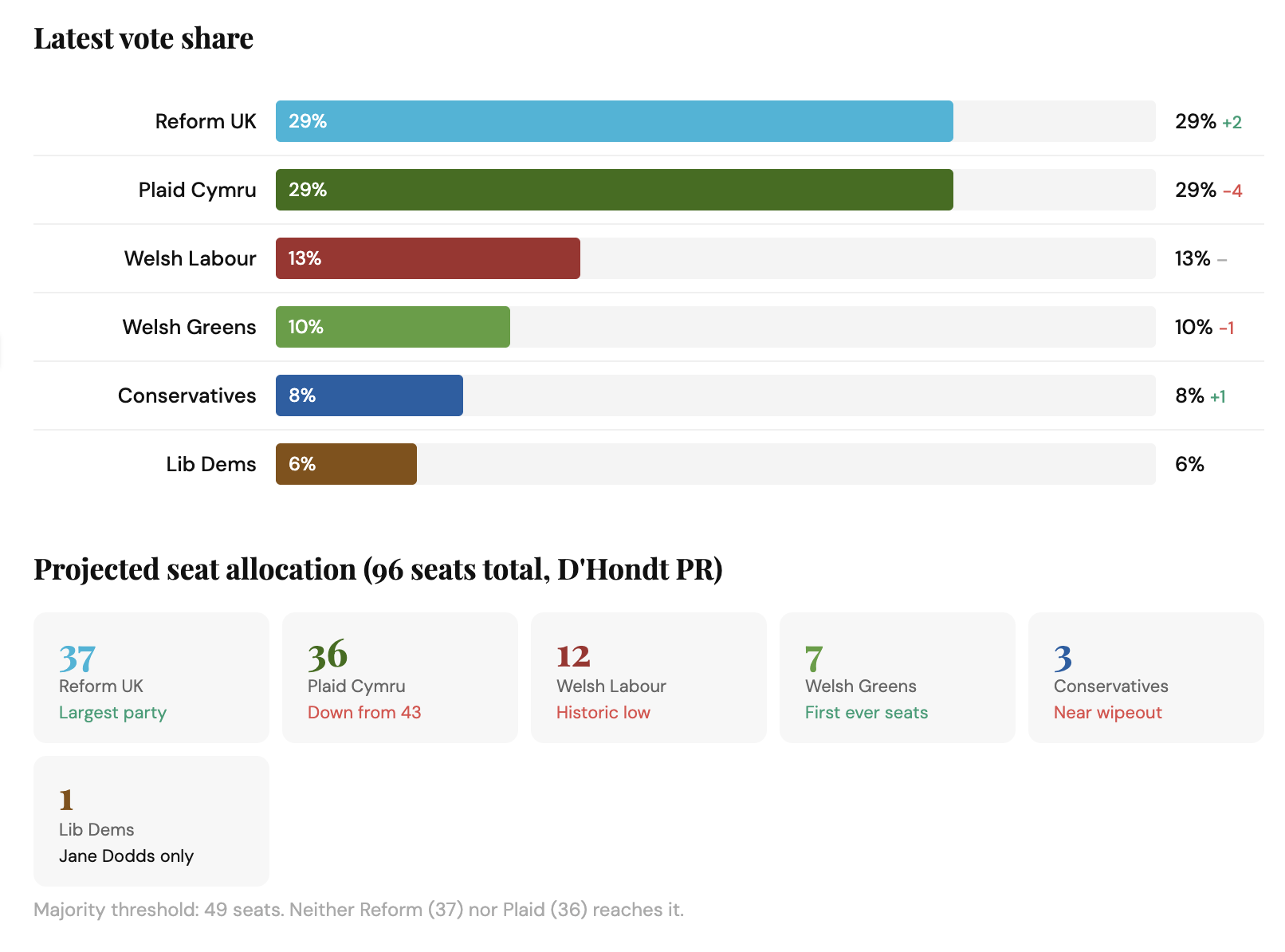
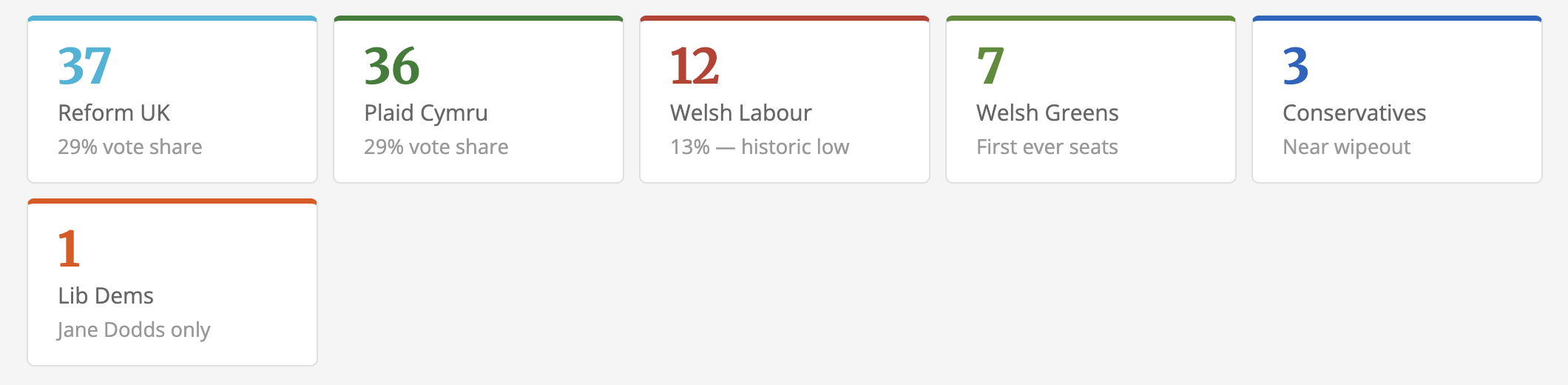
Reform is projected to win 37 seats. Plaid Cymru 36. Neither comes close to the 49 needed for a majority in the new 96-seat Senedd, which means the party with the most seats will need to form a coalition with at least one of the other parties.
For communities here in Carmarthenshire, and right across West Wales, the result on 7 May will matter in ways that go far beyond Cardiff Bay. It will determine who controls the budget that funds our NHS, our schools, our roads and our councils. It will send a signal to Westminster about whether Welsh Labour’s long grip on power was a settled fact of Welsh life — or something that could always be taken away. And it may well determine the future of Keir Starmer’s government in Downing Street.
A race that has transformed in three months
To understand how dramatic this moment is, it helps to remember where we were at the start of the year. In January, Plaid Cymru held a 14-point lead over Reform in the same YouGov series. Three months later that lead has been entirely wiped out.
In this latest poll, Plaid has dropped four points since the previous ITV Wales survey. Reform has gained two. Dr Jac Larner of Cardiff University’s Welsh Governance Centre, who analyses the polls for ITV Wales, described it as YouGov’s lowest Plaid estimate since November 2024. He cautioned against reading too much into any single result, but acknowledged that “taken alongside the broader polling trend, the signal is clear: the race for the largest party remains between Plaid Cymru and Reform UK, with every other party competing for a distant third place.”
That third place is where Welsh Labour now finds itself. The party that has governed Wales without a break since 1999 is projected to win just 13% of the vote and twelve seats. First Minister Eluned Morgan is predicted to lose her own seat in Ceredigion Penfro.
What it would mean for Carmarthenshire
Sir Gaerfyrddin, the Carmarthenshire Senedd constituency, is one of the most closely watched seats in this election. It takes in Carmarthen, Llanelli, Ammanford and the surrounding rural communities. It is an area where farming, manufacturing, public services and the Welsh language all intersect, and where the question of who governs Wales hits hardest.
Under both the YouGov and More in Common MRP models, Sir Gaerfyrddin is contested between Plaid Cymru, traditionally strong in the Welsh-speaking west of the constituency, and Reform, which has been polling above 20% even in areas where it has barely been seen before. Labour, which has dominated parts of the Llanelli corridor for generations, is being squeezed from both sides.
What a new Senedd government decides about the Welsh NHS budget, about farm subsidy policy, about roads and transport, and about how much latitude it gives to local councils to make decisions, will be felt in every village and every surgery waiting room in Carmarthenshire. The people deciding that budget will be chosen, in part, by how this county votes on 7 May.
The coalition question: why the largest party may not form the government
Here is the detail that the headline figures on their own can obscure. Even if Reform finishes with one more seat than Plaid, that does not mean Reform forms the next Welsh Government.
Under proportional representation, you need 49 seats to command a majority in the new 96-seat Senedd. Reform, on these numbers, reaches 37. Their only potential coalition partner, the Welsh Conservatives, adds just three more, bringing the total to 40. That is nine seats short of a majority. No other party has indicated any willingness to work with Reform.
Plaid, on 36 seats, is better placed despite finishing second. A combination with Welsh Labour gives approximately 48 seats, one short, but a workable minority. Add the seven projected Green seats and the arithmetic becomes more comfortable. Both Labour and the Greens have signalled openness to arrangements with Plaid.
“Finishing first may matter less than it appears. Whichever party leads on seats will face the same coalition arithmetic, and that arithmetic is far more favourable to Plaid than to Reform. A situation where Reform UK are the largest party but find themselves in opposition will nonetheless be a novel one for Welsh voters still adjusting to the realities of proportional government formation.”
Dr Jac Larner, Cardiff University Welsh Governance Centre
Plaid leader Rhun ap Iorwerth has said he would prefer to lead a minority government on Plaid’s own, rather than enter a formal coalition. Whether that preference survives contact with the arithmetic of a 96-seat chamber will be one of the defining questions of the post-election period.
What this means for Keir Starmer and Westminster
Beyond Wales, this election has taken on an unusually large significance for the future of UK politics. Westminster politicians and commentators are watching Cardiff Bay closely, because a heavy Labour defeat in Wales carries consequences that reach all the way to Downing Street.
Wales has been Labour’s most loyal ground in British politics for over a century. The Welsh valleys returned Labour MPs in elections that devastated the party everywhere else in England and Wales. Even in Boris Johnson’s landslide of 2019, Labour performed better in Wales than almost anywhere. When a heartland like this turns against a party, it does not go unnoticed.
The polling data from Wales is damning for the UK government. YouGov’s spring 2026 survey found that seven in ten Welsh adults, including more than half of people who voted Labour in the 2024 general election, believe Keir Starmer is doing a bad job as Prime Minister. His net approval rating in Wales stood at minus 51. The removal of the winter fuel allowance, the retention of the two-child benefit cap, welfare reform cuts and the failure to devolve the Crown Estate to Wales have each taken their toll.
The Mandelson affair has deepened the damage. The revelation that Starmer appointed a former ambassador who had failed his security vetting, overruled by the Foreign Office within 48 hours, and whose ties to convicted sex offender Jeffrey Epstein were subsequently exposed, struck a particular nerve in communities that hold Labour to a standard of integrity it now appears unable to meet. Starmer’s chief of staff Morgan McSweeney resigned over the appointment in February. Mandelson himself was arrested on suspicion of misconduct in public office in late February and remains on bail. First Minister Eluned Morgan ordered her own Welsh Government review of communications with Mandelson after Plaid demanded it.

Multiple political analysts have noted that Labour MPs in Westminster are already treating the Senedd result as a potential trigger for a leadership challenge against Starmer. A catastrophic result, Labour third, the First Minister losing her seat, the valleys no longer returning Labour members, would provide exactly the kind of shock that emboldens those who have already been questioning his leadership. If Wales falls, the argument that Starmer is leading a party capable of rebuilding its coalition becomes significantly harder to make.
The Senedd’s relationship with Westminster: a fault line that runs through this election
One of the currents running beneath this election that rarely gets the attention it deserves is the question of what kind of relationship the next Welsh Government will have with Whitehall.
For 27 years, Welsh Labour in Cardiff Bay and Labour governments in London operated, broadly, as partners, sometimes fractious ones, but partners nonetheless. That relationship is now broken. Morgan has been publicly critical of Westminster decisions and has repeatedly had to defend Welsh communities against policies imposed from London that she has no power to reverse.
A Plaid-led government would represent a qualitatively different dynamic. Plaid is committed to Welsh independence in the long run, and even in the shorter term would push for greater devolution, more fiscal autonomy, and a more assertive defence of Welsh interests against Westminster encroachment. Relations with a Starmer government would likely be confrontational, politely so at first, but confrontational.
A Reform-influenced Senedd, even in opposition, would create its own friction. Reform has talked openly about questioning the value of the Senedd itself. Their Welsh leader Dan Thomas came to the role as a Barnet councillor who had not lived in Wales since 1999. The party’s manifesto promised to reverse the 20mph speed limit, abolish Natural Resources Wales, and pursue a programme closer to what Nigel Farage has been advancing in England. How that agenda intersects with a progressive Plaid or Labour-Plaid coalition government would produce some of the most combustible politics Cardiff Bay has seen in its 27-year history.
The Caerphilly precedent: and why polls do not always reflect final votes
Before anyone reads too much certainty into any of these projections, it is worth revisiting what happened in Caerphilly last October.
In the weeks before that by-election, a poll gave Reform a four-point lead over Plaid. On the day, Plaid won by more than eleven points. The final result was almost the mirror image of what the poll had suggested. Analysts attributed the discrepancy to tactical voting, higher-than-expected turnout among younger voters, and a late squeeze as undecided voters concluded they did not want Reform to win.
ITV Wales political editor Adrian Masters made the point plainly after Tuesday’s poll was published. Wherever journalists have gone in Wales during this campaign, they have consistently found two things: a sizable and energised Reform base, and a significant number of people who say they want anyone but Reform in power. Whether those voters translate their feelings into votes, and whether Plaid can mobilise the younger turnout it needs, remains the central unknown of this election.
What the other polls show
The latest YouGov MRP is the most dramatic projection of the campaign so far, but it is not entirely out of step with other recent surveys. More in Common’s MRP from this week put Plaid on 30 seats and Reform on 28, with Labour on 24, broadly similar in direction if slightly less stark in the Labour figure. The PollCheck 5-poll moving average, as of 20 April, still shows Plaid fractionally ahead on 28.6% to Reform’s 26.4%, suggesting the single YouGov poll may slightly overstate Reform’s position. What all models agree on is that both Plaid and Reform are far ahead of anyone else, Labour is in serious trouble, and the Greens are on course to win Senedd seats for the first time.
Sixteen days to shape a generation
Whatever happens on 7 May, Welsh politics will not look the same on 8 May as it did when the year started. A party that has never governed Wales is going to come within touching distance of power, or take it. A party that has governed without interruption for 27 years is going to suffer its worst result in any major election since devolution began. The Senedd itself, expanded from 60 to 96 members under an entirely new voting system, will look and feel different from anything Wales has experienced before.
For people in Carmarthenshire, the question is a practical one:
Who, come the morning of 8 May, will be making the decisions about NHS Wales, about farm payments, about energy costs, about roads and schools and planning?
Who will be representing Wales in negotiations with Westminster, and what kind of relationship with London will they bring with them?
Those are not abstract questions. They are the questions that will determine what this county looks like for the next four years.
The polls are telling us it is too close to call. The voters of Wales will tell us the rest.