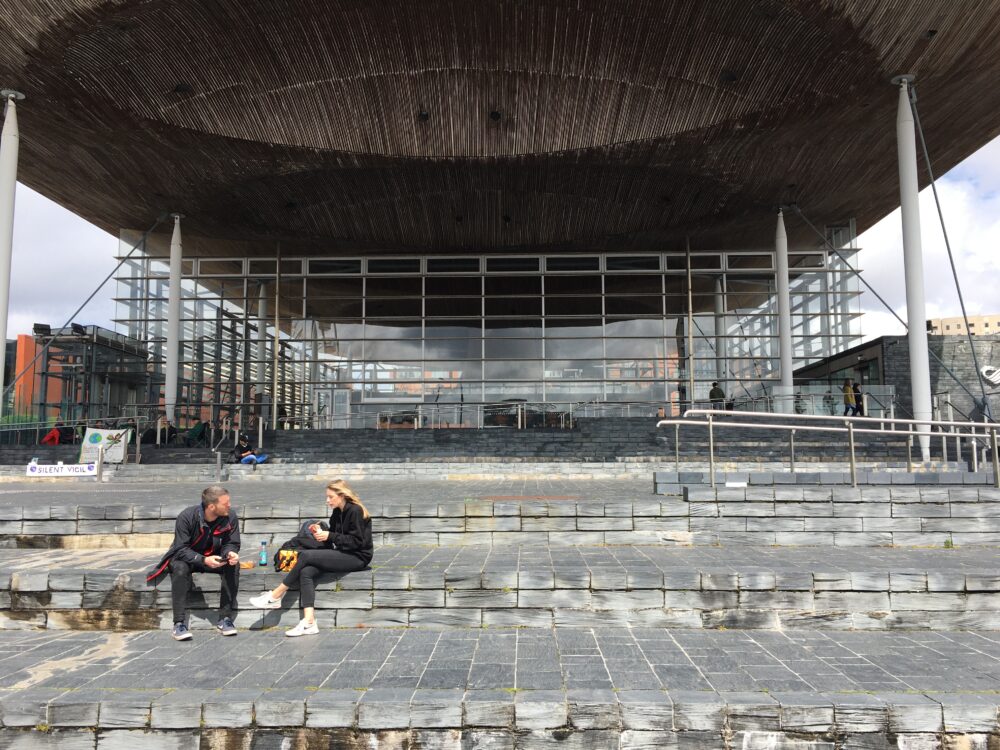
[tta_listen_btn] Wales is days away from a Senedd election unlike any before it. The new proportional voting system means every ballot cast will carry genuine weight. The outcome is not yet written. And for the first time in 27 years, Labour is not the story.
Two parties are leading neck and neck to form the next Welsh Government: Plaid Cymru, the party of Welsh national identity and public investment, and Reform UK, the party channelling deep frustration with the political establishment. Both are polling within a single percentage point of each other. Both are making sweeping promises. Both deserve honest scrutiny.
A Plaid Cymru Wales: Nation-Building from the Ground Up
A government led by Rhun ap Iorwerth promises to arrive with a clear domestic mandate and a philosophy rooted in public investment, social solidarity, and the long-term construction of a more self-sufficient Wales.
On the NHS, the institution born in Wales and the defining test of any Welsh government, Plaid proposes a costed, targeted plan to cut waiting lists. That includes ten new surgical hubs to speed up treatment for procedures such as hip replacements, knee operations, and cataract removals, alongside a new Minister for Public Health to ensure physical and mental wellbeing is central to all Welsh Government decisions. In a country where around one in five people are on an NHS waiting list, this is not an abstract aspiration. It is an urgent necessity.
On the economy, Plaid’s instinct is to invest in Wales from within. The party pledges to increase public procurement from Welsh-based suppliers from 55 to at least 70 per cent, reform business rates to level the playing field for high street businesses, and create a Wales Wealth Fund to ensure Wales profits from its own resources rather than seeing returns flow elsewhere.
Families with young children would feel the change most directly. Plaid’s flagship childcare offer would provide 20 hours a week of free childcare for children aged nine months to four years, available 48 weeks a year. Accompanying it is the Cynnal payment, a weekly direct child benefit modelled on the Scottish Child Payment, aimed at breaking the cycle of child poverty.
Culturally, a Plaid government would be transformative for Welsh-speaking communities and for the broader identity of the nation. Policies to grow the number of Welsh speakers and strengthen the use of Welsh in public services and education would deepen Wales’s distinctive character. The retention of the Anti-Racist Wales Action Plan signals what kind of nation this party believes Wales should be.
Plaid’s Wales is one that sees public services not as a burden but as the foundation of a functioning society.
What Plaid Says Versus What Plaid Does
For a party that has never governed alone, Plaid’s record of translating influence into tangible policy is more substantial than its critics tend to acknowledge.
The clearest test came through the Co-operation Agreement signed with Welsh Labour in December 2021. The agreement covered 46 policy areas and was ratified by 94 per cent of Plaid’s membership. Crucially, Plaid entered it not as a junior coalition partner with ministerial seats, but as a policy engine operating alongside government, an arrangement designed to let it claim credit for delivery while retaining the freedom to oppose Labour where it disagreed.
And deliver it did, in measurable ways. Universal free school meals were rolled out for primary school pupils: 15 million meals served, 142,000 pupils made eligible. This was not a pilot or a consultation. It was a child fed at lunchtime who might not otherwise have been. Ynni Cymru, a publicly-owned energy company, was launched to expand community-owned renewable generation across Wales, a genuinely radical piece of economic architecture in a country whose energy resources have historically been extracted with little return to local communities. Free childcare was extended to all two-year-olds, with particular focus on Welsh-medium provision. Radical second-home legislation was introduced, offering some protection to Welsh-speaking rural communities facing cultural erosion through a tide of holiday properties pricing out local families.
Where Plaid Falls Short: The Honest Reckoning
A party that asks to be taken seriously must account for its failures as well as its achievements. Plaid has genuine ones.
The most damaging was internal. A report commissioned by Plaid’s own leader, Adam Price, revealed a culture that had failed to implement a zero-tolerance approach to sexual harassment. Staff had felt unsafe raising concerns, and bad behaviour by elected members had been tolerated. Price resigned in May 2023. For a party built on moral seriousness about the kind of Wales it wants to build, it was a serious and legitimate wound.
Then there is the independence question, the great cause that gives Plaid its animating purpose, and yet one that has become, in recent election campaigns, something of a strategic inconvenience. Rhun ap Iorwerth has stated that an independence referendum would not come in a first term. For true believers, this feels like perpetual deferral. What reads as pragmatism to swing voters reads as surrender to the Welsh-speaking communities that have sustained the party through its lean decades.
The Co-operation Agreement also had its limits. Some commitments stalled, diluted by budgetary pressures or Labour’s institutional inertia. When Plaid finally walked away in May 2024, it was not on policy grounds but over the donation scandal surrounding First Minister Vaughan Gething, a principled stance, but one that left unfinished business on the Welsh Language Education Bill and fair rents legislation.
The Carmarthenshire Question: Emlyn Dole’s Legacy
In Carmarthenshire, Plaid’s heartland, a long period of council leadership under Emlyn Dole left a legacy that sits uneasily alongside the party’s stated values of transparency and accountability.
In opposition, Dole and his Plaid colleagues had been vocal and at times cutting about Labour’s secrecy and poor governance. Then they took power, and the story changed. What became known locally as ‘barngate’ centred on a planning application for a barn conversion submitted by Dole’s wife in 2012. Carmarthenshire’s own planning officers recommended rejection. The planning committee overruled them by a single vote, with fellow Plaid and Independent councillors carrying the decision. Dole declared his interest and took no part in the debate, but for a party that had built its Carmarthenshire identity on opposing exactly this kind of governance, the optics were damaging.
Local commentary also suggested that Dole’s path through the planning process had been smoothed by the chief executive, and that the price paid was his reversal of his earlier condemnation of an unlawful payments fund at the council, a fund he had previously attacked with vigour in opposition. No formal finding was ever made against Dole personally. In 2022, Plaid won a majority across Carmarthenshire for the first time, while Dole lost his own seat. Local voters, it appeared, had drawn their own conclusions.
Rhun ap Iorwerth’s inheritance is a party with a genuine record of delivery and a genuine record of falling short, sometimes because it lacked power, sometimes because it lacked the internal discipline to match its rhetoric. What is undeniable is that Plaid has, in the years it held real influence, used that influence to put food in children’s mouths, to build publicly-owned green energy, and to protect communities under threat. Those are not gestures. They are precedents.
A Reform Wales: The Politics of Frustration Made Manifest
To dismiss Reform’s surge in Wales as mere protest voting is to misread both the party and the people drawn to it. Post-industrial communities that have watched decades of deindustrialisation, endured some of the longest NHS waiting times in Britain, and seen public services stretched beyond capacity have every reason to want something different. That frustration is entirely legitimate, and Reform has built its entire Welsh campaign around giving it a voice.
The NHS and the cost of living are the dominant issues for Welsh voters, cited by 74 and 67 per cent of the electorate respectively. After 27 years of Labour governance, those are not abstract statistics, they are the daily experience of people waiting months for treatment, struggling with energy bills, and watching high streets hollow out.
Reform’s five core pledges for Wales: cut taxes, scrap blanket 20mph limits, put Welsh people first, build Wales for the future, and back Welsh farmers, are deliberately plain-spoken. On the NHS, they propose expanding surgical hubs, eliminating corridor care through national patient flow standards, and establishing a new dental school for Bangor and Aberystwyth. On infrastructure, they promise to build the M4 relief road, upgrade the A55 North Wales expressway, and fast-track improvements to the A470. On the economy, they pledge a 1p income tax cut across all bands, a modern industrial strategy, and a minister for industry to advocate for key sectors including Welsh steel.
These are not incoherent positions. They tap into something real: the sense that Wales has been managed rather than led, administered rather than transformed, and that 27 years of the same party has produced complacency masquerading as governance.
The frustration driving voters toward Reform is real. The party offering itself as the answer is a very different matter.
What Reform Has Not Answered
The income tax cut is the headline economic offer, and it deserves examination. Reform states it will be delivered through efficiency savings, but without cuts to frontline services, a position that independent analysts have found difficult to reconcile. In a country where the public sector accounts for a higher share of the workforce than almost anywhere else in Britain, the practical meaning of efficiency is something Welsh voters would do well to interrogate carefully.
Then there is the question of the party’s internal character, which in the weeks before polling day has become impossible to ignore. Caroline Jones, a former UKIP Assembly Member who joined Reform and became one of its most prominent Welsh figures, resigned in April 2026. She cited serious concerns about parachuted candidates and allegations of racism and discrimination against some of those placed on constituency lists. She described her experience of raising those concerns formally as being met with a wall of silence. Her resignation added to a growing picture of turmoil inside Reform’s Welsh operation, including the collapse of its Bridgend candidate slate, a furious resignation in Swansea in which a candidate branded the party a ‘sewer’, and a Carmarthenshire campaign launch overshadowed by further defections.
A Reform insider who took part in the party’s vetting procedures described the process as not merit-based, designed to find the best local representatives, but centrally controlled, favouring insiders, parachuted candidates, and personal connections over local knowledge and competence.
There is also the matter of leadership. Dan Thomas was announced as Reform’s leader in Wales in February 2026, having moved away from Wales in 1999 and spent the subsequent years as a Conservative Party councillor on Barnet London Borough Council. The party asking to govern Wales is led, in Wales, by a man who has spent the past quarter century elsewhere, a biographical detail that sits uneasily with a campaign built on putting Welsh people first.
And there is a deeper constitutional tension running through Reform’s Welsh operation. Nigel Farage has at various points described the Senedd as a very expensive mistake, calling for its abolition or significant curtailment. Welsh voters are being asked to elect a Welsh Government through a party whose national leadership has questioned whether that government should exist. Reform also makes prominent promises on immigration, a power reserved to Westminster, over which the Senedd has no authority.
Reform in Power: The English Councils Test
Every party makes promises. The meaningful test is what happens when the promises meet reality. For Reform, that test has now been run, not in Wales, but across ten English councils where the party swept to power in the May 2025 local elections.
The centrepiece of Reform’s local government offer was straightforward: slash the waste, cut the fat, reduce your taxes. Kent County Council was held up as the party’s own flagship. Before the election, Reform’s then-chairman Zia Yusuf told BBC viewers directly: they don’t want their council tax going up, and Reform will deliver on that.
Within months, Kent County Council had racked up a 46.5 million pound budget overspend, a figure that increased by 66 per cent in just three months and which the council’s own analysis described as critical. The party that had promised to find the hidden waste discovered, as one of its own cabinet members put it, that services were already down to the bare bones. In the end, Reform raised taxes in every council where it holds or shares power.
When confronted with his own election leaflet promising voters in Kent to reduce waste and cut your taxes, Nigel Farage told ITV News: we did not say we would cut tax. When challenged on the wording, he added: cutting taxes could mean not putting them up as much, I suppose.
Reform had built its pre-election narrative around cutting spending on diversity and inclusion initiatives and DEI officers, framing these as the source of the waste. But expenditure on those areas turned out to be negligible. In Kent, more than 787 million pounds, nearly half the entire budget, goes on adult social care. The grand efficiency drive had nowhere to go, because the waste Reform had promised its voters simply did not exist at the scale required.
A Pattern of Conduct, Not Isolated Incidents
The broken budget promises would be damaging enough on their own. But running alongside them has been something more troubling: a pattern of conduct among Reform’s elected representatives that speaks to the character of the movement itself.
Within four months of the May 2025 elections, at least 15 Reform councillors had been suspended, expelled, or had quit, with at least four facing criminal investigations. Some left within days of being elected, while others were found to have shared racist content online or became subjects of police investigations. By February 2026, the party had lost 46 councillors through suspensions, expulsions, and resignations, roughly one in every eighteen elected.
In Staffordshire, the council leader was expelled after posts emerged in which he used racist language about the Mayor of London, described migrants as intent on colonising the UK, and was identified as a top supporter of a Facebook page promoting white supremacy. The new council leader vowed to act swiftly if any more Reform councillors were found to be acting in a racist way, an acknowledgement that the problem had become systemic.
This is not a distant English problem for Welsh voters. Reform’s only sitting Senedd member, and the party’s most prominent Welsh face before polling day, Laura Anne Jones, defected from the Welsh Conservatives to Reform in July 2025. In August 2024, messages were released showing her using a racial slur referring to Chinese people. In November 2025 she was suspended from the Senedd for 14 days for its use. She has also been accused of using non-disclosure agreements funded by public money to prevent staff from speaking about her conduct in office. Following her defection, Jones suggested that Reform may consider abolishing the Senedd if it cannot be made to work for Wales, making her the only sitting Senedd member in this election openly entertaining the dismantlement of the very institution she is asking to govern.
Wales, This Is Your Moment
Whatever conclusions you have drawn from what you have read here, one thing is beyond dispute: this election matters in a way that most do not. The new proportional voting system means every vote counts as it never has before. The old certainties are gone. The outcome is genuinely open.
That openness is both an opportunity and a responsibility.
Voting out of anger is understandable. The anger is justified. But anger is not a policy, and a protest vote does not fix a waiting list, build a house, or keep a school funded. Wales has real, pressing, unglamorous problems that require a government with experience, institutional knowledge, and the genuine will to solve them, not one still learning what devolved government actually means while the bills land on the mat.
Read the manifestos. Not the headlines, the detail and the fine print. Ask which promises are costed and which are not. Ask which party has used power, however limited, to deliver tangible change for real people, and which has used the campaign trail to make promises its own record elsewhere has already broken. Ask what Wales looks like in four years under each of these governments, not just on polling day.
Wales is not England. Its challenges are distinct, its communities are distinct, its culture and language are unlike anywhere else on earth.
The party that governs Wales from Thursday should understand that, not as a a slogan, but as a governing principle.
Vote. Vote carefully. Vote for the Wales you actually want to live in, not just against the Wales you are tired of. Those are not always the same ballot paper.
This is an editorial analysis piece. It represents the considered view of the Carmarthenshire News Online editorial team based on publicly available information, party manifestos, Senedd voting records, and independently verified reporting. It is not a party political broadcast for any party.
Carmarthenshire News Online, Independent News for Sir Gaerfyrddin | carmarthenshirenewsonline.com