[tta_listen_btn] In her 2026 Sir David Nicholas Memorial Lecture, Deborah Turness, Chief Executive of BBC News, issued a warning that the traditional news industry is struggling to keep pace with what she called the creator journalism ecosystem. Audiences are leaving institutional broadcasters and newspapers for the directness, personality and intimacy of independent voices: podcasters, Substack writers, and figures like Joe Rogan and Piers Morgan who have built vast followings precisely because they feel nothing like the organisations Turness leads.
It is a warning worth taking seriously here in Carmarthenshire, and across West Wales more broadly. We have watched the demise of local newspapers at close range. We have seen newsrooms consolidate and relocate to cities, chasing volume and advertiser metrics while the communities they once served are left without coverage. The stories that matter most to the people of Sir Gaerfyrddin, a planning committee decision in Llanelli, a hospital waiting list in Glangwili, a pollution discharge in the Towy, do not generate the kind of traffic that keeps a city desk interested. They generate the kind of truth that keeps a community informed.
Turness is right that traditional media is at a crossroads. For hyperlocal journalism, the crossroads is sharper, the traffic faster, and the consequences of standing still more severe. But the argument here is not one of despair. It is one of adaptation, honest about the scale of the challenge and clear-eyed about what the tools now available can do.
AI in the Newsroom: A Force Multiplier, Not a Replacement
Hyperlocal newsrooms are chronically underfunded and understaffed. That is not a complaint. It is a structural fact of the economics of regional journalism, one that no amount of editorial commitment can wish away. The question is not whether to find efficiencies but where to find them without sacrificing the journalism itself.

The ethical integration of artificial intelligence offers a genuine answer to that question. Not as a replacement for the human reporter, but as what one of our own team described simply and accurately as having a team of interns and an editor on hand to help with the research and summaries.
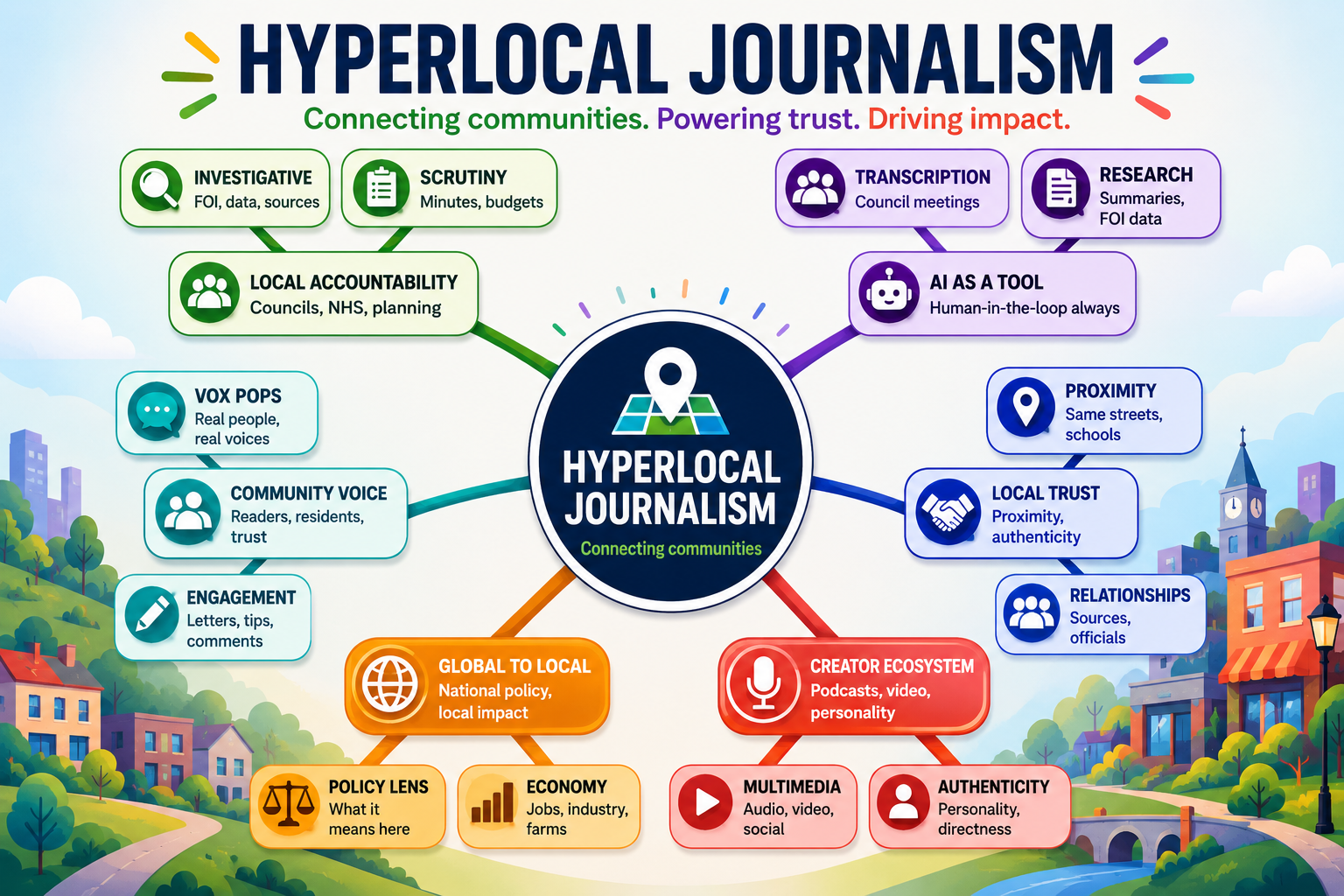
The practical applications are already changing how we work. AI handles real-time transcription of lengthy council meetings that would previously have consumed hours of desk time. It processes and summarises public notices, planning applications, and government budget documents, flagging discrepancies that a single reporter working under deadline pressure might miss. Elkanah, our graduate reporter, has demonstrated what is possible: court reports that would previously have taken the best part of a day to compile are now processed and summarised in minutes, freeing time for the stories that require a journalist to be present, in the room, in the community.
“It is like having a team of interns and an editor on hand to help with the research and summaries.” Our junior reporter on working with AI in a hyperlocal newsroom.
AI also serves as what might be called a global-to-local translation engine. The people of Carmarthenshire do not live in a vacuum. National policy decisions, international supply chain pressures, and global economic shifts land on their doorsteps in ways that often go unexplained by media more interested in the macro than the micro. AI allows us to process complex national and international data and synthesise it into the local context it deserves: what does this mean for a farmer in Cynwyl Elfed, a steel worker in Port Talbot, a family in Johnstown managing an energy bill that has doubled in three years?
Elkanah has also built our podcast platform using AI tools, generating audio jingles and production elements that would previously have required specialist contractors and significant cost. The barrier to multimedia journalism, for a newsroom of our size, has dropped substantially. That matters.
If you value what we do, please consider making a donation to keep Carmarthenshire News Online running.
The Line That Cannot Be Crossed
None of this comes without a condition that is non-negotiable. AI must never be granted autonomous publication authority. Every AI-generated lead, data summary, draft or transcription must pass through a human journalist with an intimate knowledge of the local landscape before it goes anywhere near a reader.
This is not a bureaucratic rule. It is the entire point. The value of hyperlocal journalism is not speed or volume. It is trust. The human reporter is the primary guarantor of that trust: the person who knows that the planning officer’s name was misspelled in the automated summary, that the councillor quoted has a relevant interest that the data does not flag, that the story behind the story requires a phone call to someone who will only speak off the record to a journalist they know. AI cannot replicate that knowledge. It can only serve it.
In line with Turness’s call for transparency across the industry, we are committed to making clear to our readers when and how AI tools have been used in our journalism. That transparency is itself a form of accountability, and it is one that distinguishes ethical AI integration from the kind of wholesale automation that produces content without producing journalism.
The Creator Ecosystem and the Frog in Boiling Water

Turness’s lecture made the case that the podcast and creator market is not a sideshow. It is the show. Projected to grow to a market worth 114 billion dollars by 2030, it has captured audiences that institutional journalism once took for granted, and it has done so by offering something that studios in London and Washington struggle to replicate: directness, connection, and the sense that the person speaking to you actually means it.
The lesson for hyperlocal journalism is not to imitate Joe Rogan. It is to recognise what his audience is responding to, and to understand that a local journalist who shops in the same market as their readers, whose children attend the same schools, whose name is known in the community they cover, already has something Rogan does not. The challenge is to use it.
There is nothing preventing hyperlocal outlets from embracing the personality-driven, multimedia, authentically conversational format that creator journalism has normalised. We are already moving in that direction. The newsrooms that treat this shift as a passing trend, the frog in the boiling water that does not notice the temperature rising until it is too late, will not survive the next decade of media economics. The ones that adapt, that combine the credibility of genuine local accountability journalism with the accessibility of modern digital formats, have a more defensible position than any national broadcaster.
If you value what we do, please consider making a donation to keep Carmarthenshire News Online running.
Why Local News Cannot Be Allowed to Disappear
When local journalism dies, the consequences are not abstract. Corruption in local planning goes unreported. Hospital failures accumulate without scrutiny. Council budgets are set without anyone asking the questions that residents cannot ask themselves because they do not have access to the documents or the meetings or the officials.
National broadcasters do not have the resources, the local knowledge, or frankly the incentive to investigate a failing planning committee in West Wales or a budget discrepancy in a Carmarthenshire school. Carmarthenshire News Online does. That is not self-promotion. It is a structural reality of how local accountability journalism works, and it is precisely the journalism that Turness identified as being most at risk.
Trust in national news has collapsed, in part, because audiences feel that the institutions covering them are distant, indifferent, and more interested in the agenda of the newsroom than the reality of the community. Local news has a natural and irreplaceable advantage over that: proximity. Our journalists live here. The accountability we exercise is personal in a way that no network can manufacture.
If sites like Carmarthenshire News Online disappear, the raw material of truth disappears with them. The creator ecosystem reacts to and debates the news. It rarely funds the work of finding it.
The Stakes
Turness framed her lecture as a call to action for an industry she believes is running out of time. We agree with that assessment, and we would add one observation specific to the hyperlocal context: the communities that lose their local news do not simply lose a service. They lose a civic voice. The stories that hold power to account at the local level, the ones that require someone to attend the meeting, read the document, knock on the door, and ask the question, do not get told by anyone else. They simply do not get told.
The ethical use of AI, a genuine commitment to the community we serve, and a willingness to adapt our formats and platforms without abandoning our values, are not guarantees of survival. But they are the best available answer to the question Turness posed in her lecture: what does journalism that people actually need, actually trust, and are actually willing to support look like in 2026?
For us, it looks like this. And we intend to keep making it.
Support independent local journalism in Carmarthenshire.
Carmarthenshire News Online is an independent publication. It is not funded by local or national government, and carries no advertising obligations that influence its editorial decisions. All AI tools used in our journalism operate under a strict human-in-the-loop editorial standard.
Carmarthenshire News Online, Independent News for Sir Gaerfyrddin | carmarthenshirenewsonline.com