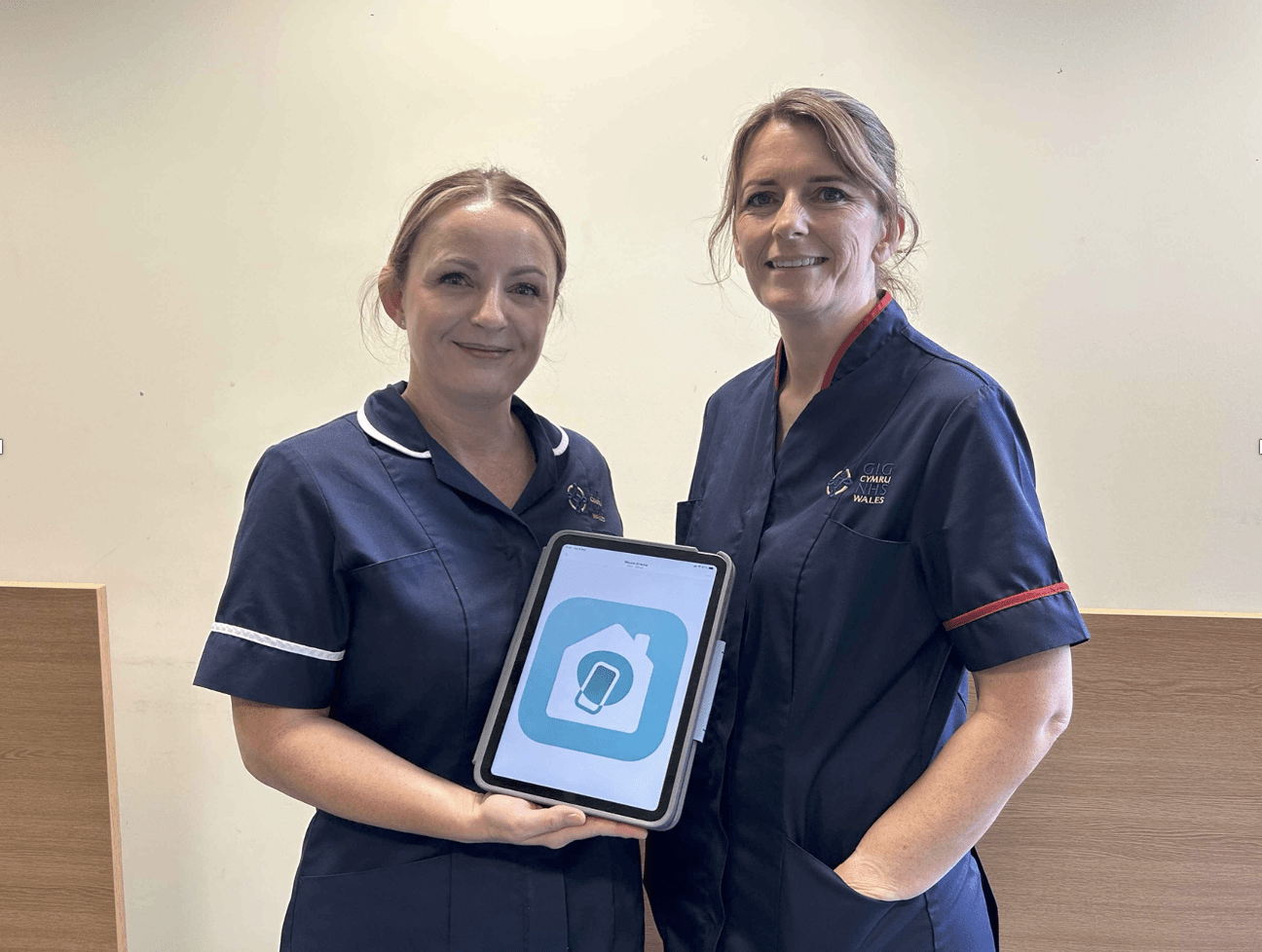
Pictured: Karly Harvey, operational clinical lead nurse for community wound clinic, and Catrin Codd, the health board’s Senior Professional Nurse Advocate for district nursing. Copyright: Swansea Bay University Health Board.
Swansea Bay staff have hit a milestone of using an innovative wound-scanning app which has transformed the way patients are cared for.
The Minuteful for Wound app, developed by technology company Precision Health Tech, allows staff to scan and measure wounds so they can be monitored virtually.It has been used across district nursing and the community wound clinic since being introduced in 2021, and staff have now completed more than 250,000 assessments with it.
Swansea Bay was the first health board in Wales to use the technology, which logs each image on a digital portal so staff can view them to see how they are healing. Not only does it help with the accuracy and consistency of wound assessment, but it saves time for nurses who may not need to visit the patient’s home for monitoring.
As a result of this, staff have more time to see and treat other patients, which also helps to reduce the time they have to wait to be seen.
Catrin Codd, the health board’s Senior Professional Nurse Advocate for district nursing, was heavily involved in the implementation of the app. She said:
“The introduction of the Minuteful for Wound app has transformed the way district nurses and community wound clinic assess, monitor and manage patients with wounds.
“By providing instant access to evidence-based wound assessment tools, treatment pathways and digital documentation, the app has improved consistency of care, reduced variation in practice and supported more timely clinical decision-making.
“The ability to capture and track wound progress over time has enhanced patient engagement, enabling individuals to better understand their treatment and participate in their care.”
The app has also helped the wound clinic to become paper-free, as it stores the images and documentation for staff to access.
Staff previously received the Chief Nursing Officer’s Sustainability in Nursing and Midwifery award after the switch resulted in more than 447,000 sheets of paper saved per year within district nursing and the wound clinic.
A more recent development has seen the technology evolve to allow patients to scan their wounds themselves, something that Swansea Bay is again the first in Wales to pilot.
“It is called Wound @ Home and patients download the app and they are taught to take the dressing down, scan the wound using the app and then re-dress the wound using an aseptic technique,” Catrin explained.
“Patients are then asked questions around how they are feeling, to gain more information in relation to monitoring for infection.
“Then a registered nurse will review the uploaded scan and information remotely and will either respond to confirm the wound is progressing or if they think the patient needs to be seen, if there may be an infection for example, they will make an appointment for them.
“We agree timings in advance with the patient about when they need to scan their wound, and we have a process in place so that if a scan isn’t logged, we can contact them.”
As a result of the new development, the number of clinic appointments and home visits have reduced, creating more capacity within the service for staff to see more patients.
It has also helped the team to reduce its carbon footprint by reducing the number of home visits.
Karly Harvey, operational clinical lead nurse for community wound clinic, said: “The app has also helped patients to have more autonomy around their care.
“It has empowered them to become more involved and engaged in their care.
“Patient outcomes around healing are usually improved with self-management, and reoccurrence rates are also lower with patients who are and have been involved in supported self-care.
“It is because they have taken on that responsibility and management around their care.
“This also helps bring care closer to home for our patients.”
Catrin added: “Overall, the app has streamlined documentation processes, improved communication across teams and released valuable clinical time, ultimately contributing to improved patient outcomes and a more efficient service.
“The inclusion of wound photography has strengthened investigations by providing an accurate visual record of wound progression, supporting evidence-based reviews, shared learning and improved patient safety.”
Paula Heycock, Head of Nursing for the health board’s Primary Community Therapies Group, said: “By embracing this digital wound app we are harnessing digital innovation to support evidence-based clinical decision making and reduce unwarranted variation in wound care.
“It has helped with improving outcomes and experiences for our patients, encouraging co-production.
“It is a key enabler in delivering safer, consistent, effective care across our services.”