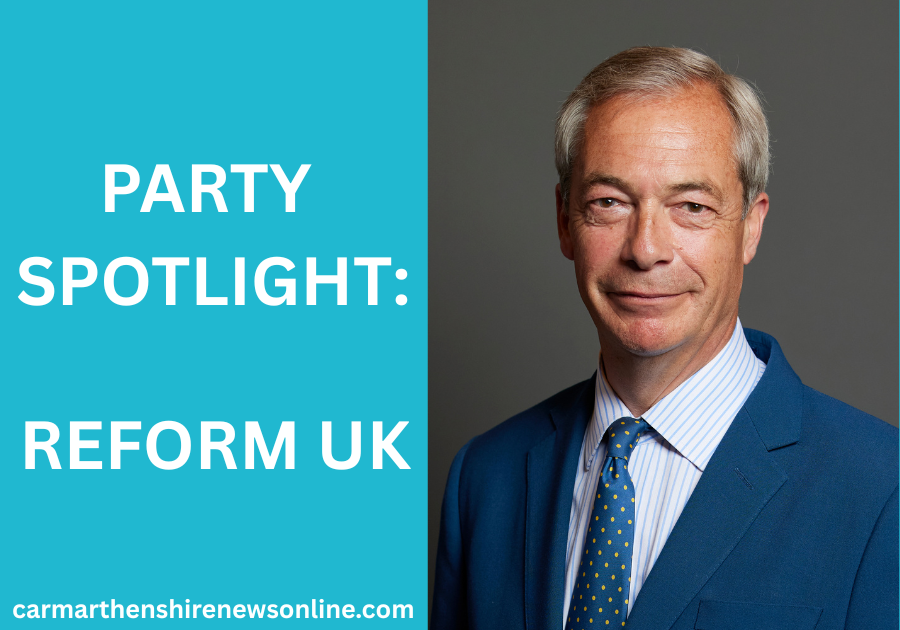
Official portrait of Nigel Farage MP, – https://members.parliament.uk/member/5091/portrait
[tta_listen_btn] Reform UK enters the final stretch of the 2026 Senedd election campaign as one of the most closely watched parties in the race, and one of the most contested. Polling neck and neck with Plaid Cymru and well ahead of a faltering Welsh Labour, the party led by Nigel Farage has surged to a position of genuine electoral relevance in Wales. Yet the campaign trail has been strewn with controversy, reported in the mainstream media.
From candidates stepping down citing “poor internal decision making” to individual politicians facing scrutiny over their past conduct, Reform’s Welsh operation has attracted sustained criticism, not only from its political opponents, but from its own members. Carmarthenshire News Online has gathered all the information to date, on Reform UK in Wales and what could impact them most at the polls in May.

A fractured selection process
Before any individual candidate controversies could take hold, Reform’s candidate selection process itself became a story. Several candidates stood down in the weeks before the April 9th nomination deadline, citing strikingly similar grievances from within the party’s own ranks.
Owain Clatworthy, a Bridgend councillor, resigned from Reform’s Pen-y-bont Bro Morgannwg list citing “poor internal decision making” and “serious concerns around candidate selection.” Andrew Barry, another Reform candidate who had been announced at a Nigel Farage event, withdrew on the grounds that the party was prioritising former Conservative politicians over local people. A third, Patrick Benham-Croswell, said publicly that he believed Reform were “sinking deeper into the sewer.” A separate candidate in the Fflint Wrecsam constituency resigned after raising concerns about allegations surrounding the list’s lead candidate.
The most high-profile single incident came in late March, when a leading Reform candidate, described as a former Conservative special adviser, stood down after a photograph circulated appearing to show him performing a Nazi salute. The party’s leader, Nigel Farage, defended the candidate publicly, arguing the image had been misinterpreted.
“Reform’s candidate woes seem to go from bad to worse. Barely a day goes by without more sinister revelations emerging about the background or character of a Welsh Reform candidate.”
— Welsh Conservative source, speaking to Nation.Cymru
A Plaid Cymru spokesperson said Reform had demonstrated “chaotic infighting” and a “selection process entangled in parachutes,” adding that the party was “not serious about Wales.” Reform has not provided a detailed public response to the breadth of these selection failures, though Farage has characterised scrutiny of the party as a “media witch hunt.”
The candidates under the spotlight
Beyond the departures, a number of candidates who remain on Reform’s lists have been the subject of individual scrutiny. Welsh Labour compiled a dossier of cases it says demonstrate the party’s ‘unsuitability to govern Wales.’ The following is a neutral summary of the claims and, where available, the relevant context:
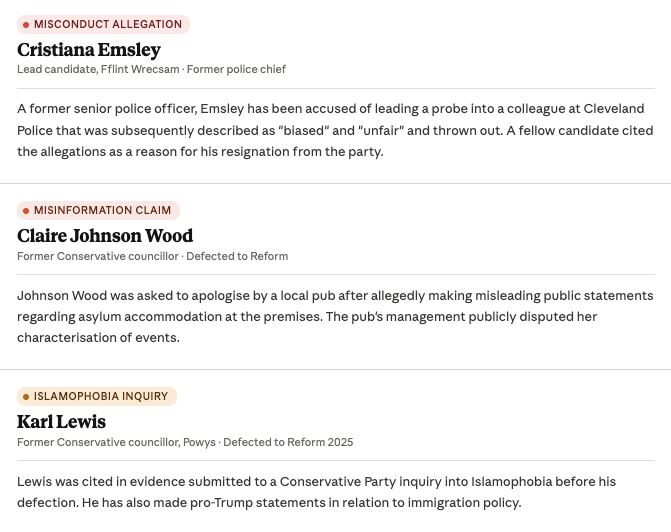
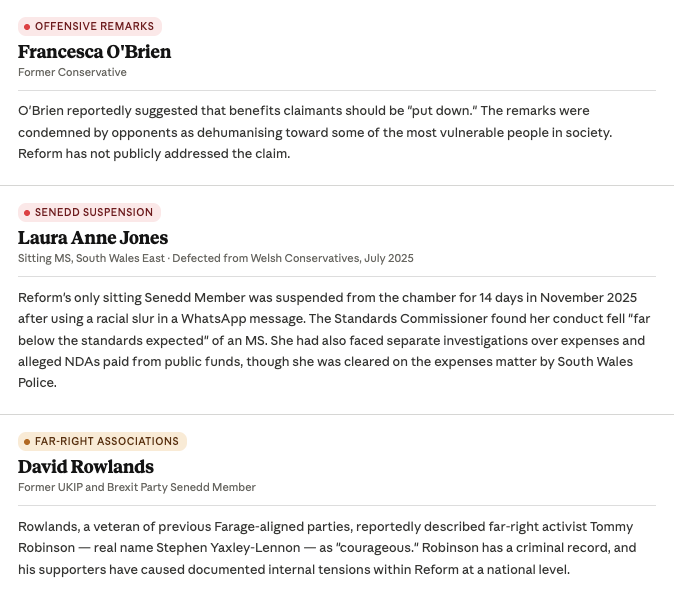
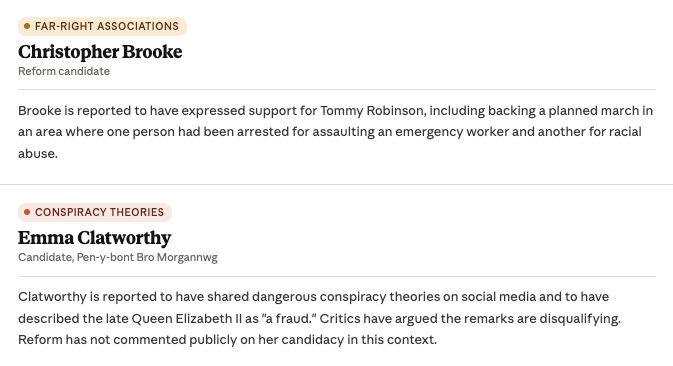
All claims are based on publicly reported allegations by mainstream media.
The broader picture: Reform’s trajectory in Wales
To understand these controversies, it helps to understand how quickly and unusually Reform has grown in Wales. The party essentially did not exist as an organised force in Welsh politics until 2024. Its current candidate base has been assembled rapidly, drawing heavily from two main sources: former Conservative councillors and politicians disillusioned with the Tory collapse, and veterans of previous Farage-aligned parties including UKIP and the Brexit Party.
Research from The Guardian found more than 60 of Reform’s local election candidates in England in May 2025 were Tory defectors. In Wales, the pattern is pronounced: multiple candidates on Reform’s Senedd lists served as Conservative councillors until recently, and Laura Anne Jones, the party’s only sitting Senedd Member, defected from the Welsh Conservative group at the Royal Welsh Show in July 2025. Former UKIP politician Caroline Jones announced she was leaving Reform as recently as 7 April 2026, citing parachute candidates being placed ahead of local members and “allegations relating to racism and discrimination.”
Context: Tommy Robinson and Reform’s internal tensions
The references to Tommy Robinson among some Welsh Reform candidates echo a broader tension that has played out nationally within the party. In November 2024, it was reported that senior figures were divided after two parliamentary candidates expressed sympathy for Robinson supporters who took part in the August anti-immigration protests, a position that drew objections from Richard Tice and Farage himself.
Farage has distanced himself from Robinson personally while defending the right of members to express a range of views. Critics argue the party has been insufficiently decisive in distinguishing itself from far-right elements that have sought to associate themselves with its brand.
Reform’s Wales leader, Dan Thomas, was only announced in February 2026. He had moved away from Wales in 1999 and was, until recently, a Conservative Party councillor on Barnet London Borough Council, a background that has itself drawn comment about the party’s local roots. The party’s manifesto was launched in Newport in early March, with Farage framing the Senedd vote as “a referendum on the Prime Minister’s leadership.”
What Reform says, and what the polls show
Reform has not made any comprehensive public response to the full range of candidate controversies. The party has characterised hostile media coverage as a “witch hunt,” and Farage personally defended the candidate photographed appearing to perform a Nazi salute, arguing it was a misinterpretation. On individual candidates, the party has largely declined to comment.
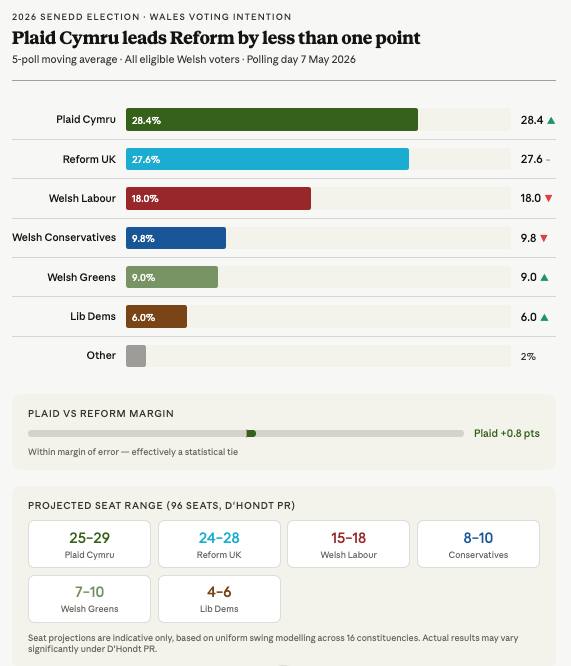
Despite, or perhaps because of, the controversy, the party’s polling position in Wales has remained competitive. The most recent Beaufort Research poll for Nation.Cymru, conducted in March 2026, put Reform on 27%, behind Plaid Cymru on 28-30% but well ahead of Labour on 17% and the Conservatives on 9%. Of thirteen polls conducted in the year before the election, Reform has led in five, Plaid in six, with one poll showing the two parties tied.
“Even by selecting these candidates, Reform have shown themselves completely unfit to govern Wales.”
— Claire Hughes MP, Labour Member of Parliament for Bangor Aberconwy
Reform has not formally responded to the specific claims made by Claire Hughes MP in the Welsh Labour dossier.
The competitive polling numbers present a paradox for the party: it is in genuine contention to become the largest or second-largest party in a newly expanded, 96-seat Senedd, yet it faces this election with no clear Welsh leader with a national profile, a candidate list that has seen multiple high-profile withdrawals and revelations, and no realistic coalition partner, with all other major parties ruling out working with it.
The stakes of May 7
The 2026 Senedd election is widely described as the most consequential in Wales since devolution began in 1999. The new proportional voting system, replacing the previous mixed-member arrangement, means seats are allocated more closely to vote share, potentially enabling Reform to win significant representation even without topping the poll in any constituency outright.
For Reform, a strong result would validate Farage’s long-standing ambition to build a durable presence in devolved politics. For its opponents, the candidate controversies catalogued above represent both a substantive critique of the party’s fitness to govern and a political opportunity to persuade undecided voters in the final weeks of the campaign.
Whether the controversies will prove decisive, or whether Reform’s core voters will regard them as Westminster-media noise, remains the central unanswered question of the Welsh campaign.