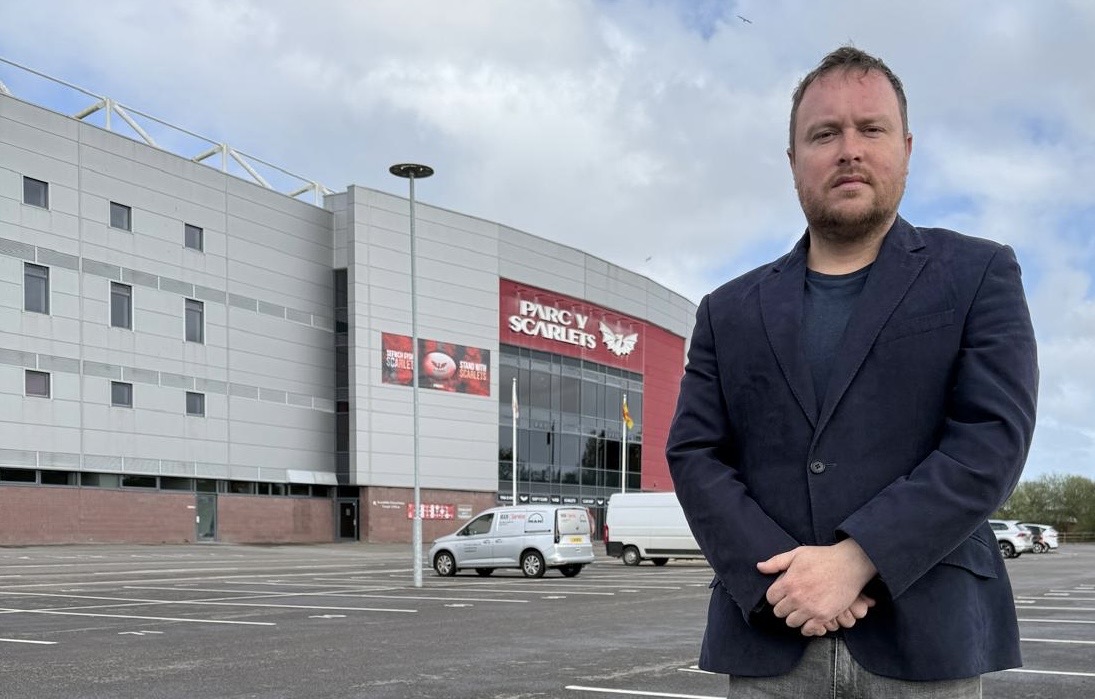
[tta_listen_btn] Jason Barker is an engineer by trade, not a career politician. He has lived and worked in Carmarthenshire for over a decade, residing in Rhandirmwyn in the upper Tywi Valley that places him at the heart of the landscape he is campaigning to protect. He describes Carmarthenshire as “a wonderful part of the country” and his candidacy is rooted explicitly in that attachment to the land rather than in lifelong ideological commitment to a political party.
He is, by his own account, a reluctant politician. His entry into the 2026 race was prompted not by ambition but by alarm, specifically, by the scale of wind turbine development planned for the Cambrian Mountains and surrounding uplands of mid and west Wales. He joined the Heritage Party because it offered him a platform and a voice on that issue. His campaign materials describe him as delighted to be standing “to make the change we need to protect and restore our nation.”
Why He Is Standing: The Wind Turbine Campaign
The defining issue of Barker’s campaign is the planned industrialisation of the Welsh uplands through large-scale wind turbine development. He frames this not as a conventional party-political argument but as an engineering-informed case against what he regards as a physically and environmentally destructive programme.
“I felt compelled to stand when I was alerted to the utter destruction planned for the Cambrian mountains in the name of Net Zero. 500 wind turbines, each around 1,000 tonnes in weight and over 850 feet tall are planned, each on upland peat bog that will require 3,000 tonnes of concrete each just to hold them up.” – Jason Barker
His candidate flyer develops this argument with a detailed technical fact sheet. Each turbine, standing 230 metres tall, more than twice the height of Cardiff’s Meridian Tower, breaks down into components that individually pose extreme logistical challenges for rural Carmarthenshire roads:
The tower weighs 700 tonnes and requires approximately ten specialist truck loads, each 70 tonnes and 20 metres long, to transport. A standard lorry carries 28 tonnes over 14 metres, meaning each tower component load significantly exceeds normal road freight limits.
The nacelle, the unit connecting the blades, weighs 200 tonnes, requires two specialist vehicles and a full police escort, and demands very heavy-duty roads and bridges along the entire route.
Each blade weighs 40 tonnes, is almost as long as a rugby pitch, requires specialist trailers and full police escort, has a working lifetime of only 20 years, is not recyclable, is buried in landfill at end of life, sheds micro-plastics from its leading edge during operation, and has blade tips moving at over 500mph, a speed he notes kills numerous birds.
The foundation for each turbine requires 3,000 tonnes of steel-reinforced concrete, plus 1,000-tonne cranes for construction, a 100-tonne base unit with support trucks, and up to 40 additional vehicles per crane assembly.
His conclusion is characteristically blunt: “It cannot be right, and it is certainly not green, to cut down healthy mature trees, grub up ancient hedgerows and dig up living peat bog for any cause. This is a gold rush that only benefits the investors and will leave our beautiful country and its heritage scarred for ever.”
Local Priorities: In His Own Words
Barker’s election communication to Carmarthenshire residents sets out seven specific local priorities:
- No wind turbines in the Welsh countryside
- No more pylons crossing rural Wales
- No industrialisation of rural Wales
- No Inheritance Tax on farms and small businesses
- End the war on farmers, removal of all green rules on farming, tree planting and rewilding that he regards as burdensome and counterproductive
- Scrap net zero ideology, which he argues drives up energy prices and damages rather than protects the environment
- End the war on cars, no ban on petrol, diesel or 4×4 vehicles, which he describes as essential for rural people and farmers in areas not served by public transport
This is a notably rural and locally focused platform compared to the broader Heritage Party manifesto. The top three priorities, wind turbines, pylons, rural industrialisation, are all directly connected to the physical landscape of Carmarthenshire and the mid-Wales uplands. The farming priorities reflect the concerns of an agricultural county where the Sustainable Farming Scheme has generated significant controversy. The defence of petrol and diesel vehicles is framed not as an ideological position but as a practical necessity for rural residents.
The Heritage Party: Context and Platform
Barker stands under the banner of the Heritage Party, a socially conservative party founded in May 2020 by David Kurten, a former UKIP London Assembly member. The party gained Electoral Commission registration in October 2020 and has stood candidates in English local elections annually since 2021, fielding 41 candidates at the 2024 UK general election. The 2026 Senedd and Scottish Parliament elections represent the party’s first devolved legislature contests.
The party’s defining constitutional position, and the one most relevant to voters in Sir Gaerfyrddin, is the abolition of the Senedd itself and the restoration of historic counties. This is an unusual position for a candidate seeking election to an institution they wish to dissolve, and Barker acknowledges the tension directly by framing his candidacy as one of opposition and disruption from within rather than participation in the institution’s normal operation.
The broader Heritage Party platform, as set out in its manifesto and Barker’s campaign materials, includes:
-
Defend British heritage and culture with Christian principles; abolish political correctness and DEI
-
Scrap net zero; repeal the Climate Change Act; reopen coal power stations; no new wind turbines or solar arrays on agricultural land; commission small modular nuclear stations
-
Leave the UN Refugee Convention; strict immigration controls; deport illegal immigrants; end migrant resettlement
-
NHS for British nationals only; foreign nationals to use private healthcare
-
Remove RSE and gender ideology from schools; reintroduce grammar schools; abolish Ofsted
-
Restore traditional marriage as between husband and wife; ban surrogacy; remove gender from law
-
Leave the Paris Climate Agreement, WHO, ECHR and Agenda 2030
-
Free market economy; re-industrialise Britain; protect steelworks; scrap carbon taxes
-
Proportional representation for UK elections; abolish regional mayors; restrict postal voting; abolish the Senedd and Holyrood
Campaign Activity and Public Profile
Despite the party’s limited resources, their total Wales and Scotland election fundraising target was £10,000, with £3,250 raised by late March 2026, Barker has been an active public presence. He spoke at a Senedd protest in February 2026 against wind turbine developments planned across mid-Wales. In March 2026 he addressed a Senedd hustings, where he argued that £320 billion has been spent on net zero in the UK since 2000, a figure he presented as evidence of the policy’s failure. His YouTube and Facebook video content, produced since December 2025, has circulated in anti-wind energy and rural communities online.
The Heritage Party alleged in April 2026 that Barker was no-platformed at a subsequent Senedd hustings event and then publicly criticised for not attending — a claim the party described as “uniparty dirty tricks.” The circumstances of that dispute have not been independently verified, but it indicates Barker’s presence had become sufficiently notable to generate a response from other parties or organisers.
His campaign flyer, professionally designed, printed and distributed, is more polished than might be expected from a party with limited funds, and suggests genuine commitment to running a visible local campaign.
Electoral Prospects
The Heritage Party does not appear in any published Wales-wide polling data. The D’Hondt threshold for a seat in Sir Gaerfyrddin is estimated at 10 to 15 per cent of the vote. On current evidence there is no realistic prospect of Barker winning a seat. His coalition potential is effectively zero, every other party in the field would decline to work with the Heritage Party, and the party’s abolition of the Senedd position removes any basis for conventional legislative negotiation.
What Barker does represent is a distinct voice on rural and environmental issues that diverges from the mainstream parties in a significant way. His opposition to wind turbines, pylons and the industrialisation of rural Wales taps into genuine local feeling, particularly in the farming and upland communities of the Tywi Valley and surrounding areas, and his engineering background lends those arguments a technical credibility that pure political rhetoric often lacks. Whether that translates into votes beyond a small, localised protest share remains to be seen on 7 May.